Endangered
Dusky kob
Dusky kob
Dusky kob, known as dusky kob in South Africa and mulloway in Australia, is a big silvery croaker fish of Indo-Pacific coasts and estuaries. It can pass 1.8 m. The IUCN Red List assessed it as Endangered in 2020 because heavy fishing has cut its numbers across much of its range.
How to recognise it
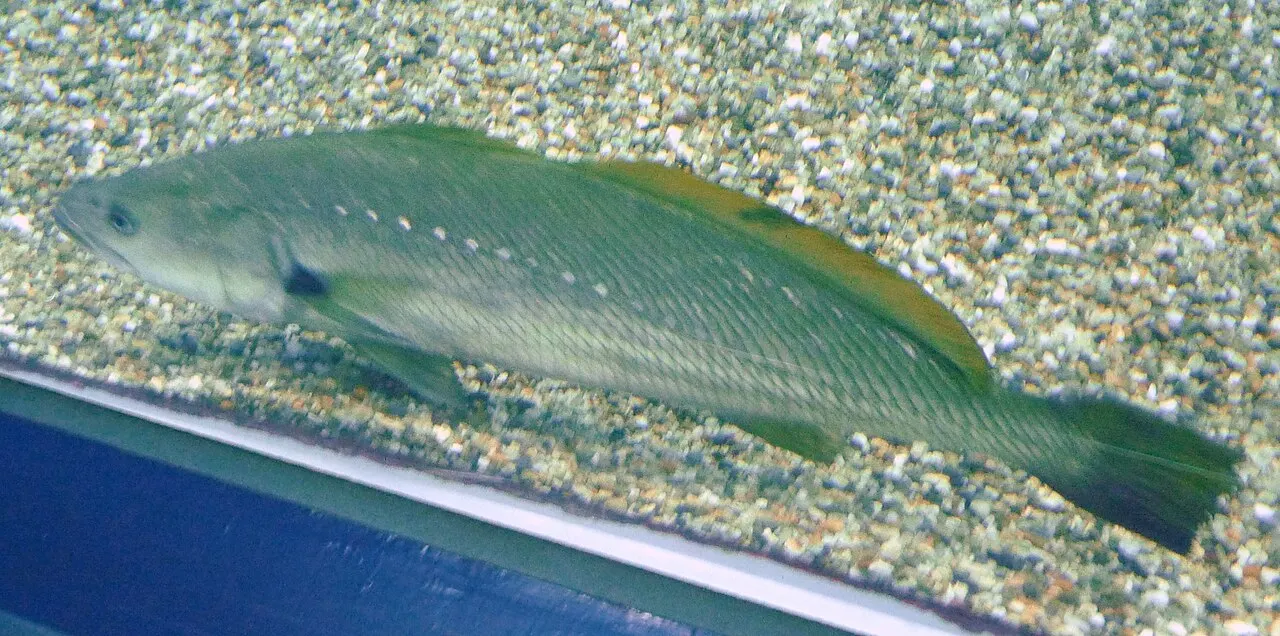
This is a large, streamlined fish with a silvery body, a bronze-green back, a paler belly and a coppery head. A row of white spots runs along the lateral line. The tail is angular in young fish and rounder in big ones. Maximum recorded size is about 2 m and 82 kg in one summary, or 181 cm and 75 kg in FishBase. The largest Australian catch on record was about 42.5 kg.
Its large ear bones, called otoliths, gave rise to the Australian name jewfish, because anglers prized them as jewels. It also goes by kabeljou, Japanese meagre (the FAO name) and, in Japan, o-nibe.
Where it lives
The range covers the Indo-West Pacific, including the southeast coast of Africa, Pakistan and northwest India, China, Korea and Japan, and southern Australia from Exmouth in Western Australia round to the Burnett River in Queensland. The IUCN lists 17 countries and territories, from Oman and the United Arab Emirates to Viet Nam and Indonesia.
Adults live mainly just beyond the surf zone and use estuaries, rocky reefs and coral reef areas. The IUCN gives a depth range of 0 to 150 m. Juveniles stay inshore and recruit into estuaries at about 30 cm.
Pins are Wikidata “endemic to” fields. Orange dots, when present, are GBIF occurrence tiles — survey bias included.
How it lives
Mulloway are meat eaters near the top of the food chain. Fish under about 150 mm eat small mysid shrimp, and larger ones switch to fish, squid and other cephalopods. In southern Africa, adults from the Western and Eastern Cape travel to KwaZulu-Natal to spawn in winter and spring.
Australian reports give a lifespan of up to 42 years, and half of fish are mature at some point between 2 and 6 years old. The IUCN uses a generation length of 23 years. FishBase rates the species' resilience as low, with a minimum population doubling time of 4.5 to 14 years, so recovery from overfishing can take a long time.
Why it is in trouble
The 2020 assessment, under criterion A2bd, lists a decreasing population trend. The named threats are large-scale harvest, small-scale or subsistence harvest, and nutrient pollution that degrades estuaries.
South Africa is the clearest case. A 2016 study in Marine and Freshwater Research found genetic signs of past bottlenecks and a low, declining effective population size in dusky kob sampled along roughly 2,000 km of coast. In New South Wales, a 2014 national review rated the stock overfished, with spawning potential estimated at only 4 to 14 percent of its unfished level, against a 25 percent threshold. A 2020 summary reportedly rated New South Wales depleted, with South Australia and Western Australia sustainable.
What is being done
The IUCN records harvest management and trade management as actions in place, a harvest management plan in place, and occurrence in at least one protected area. In New South Wales a 2013 recovery program raised the minimum size from 45 cm to 70 cm for recreational and commercial fishers and cut the recreational bag limit by 40 percent. South Africa reportedly limits shore anglers to one fish a day, and only one over 110 cm.
Sources
Written for this catalog in our own words from the sources below, checked against them on 12 November 2026. Population figures are estimates and carry the year they were made. Status and assessment year: IUCN. 2026. The IUCN Red List of Threatened Species. Version 2026-1. iucnredlist.org.




