Endangered
Arcidens wheeleri
Arcidens wheeleri
The Ouachita rock pocketbook (Arcidens wheeleri), also called Wheeler's pearly mussel, is a freshwater mussel of rivers in southeastern Oklahoma, southwestern Arkansas and northeast Texas. It was rated Endangered by the IUCN in 2011, and only one of its small, isolated populations is considered viable.
How to recognise it
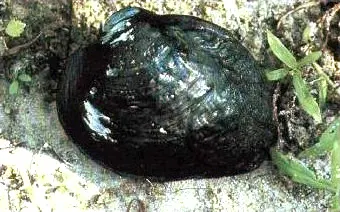
This is a medium-sized mussel with a nearly egg-shaped, moderately inflated shell about 4.5 inches (11 cm) long at most. The outside is chestnut brown to black with a silky luster and looks slightly iridescent when wet. The rear half usually has low ridges. Inside, the pearly lining is usually salmon-coloured in the upper reaches of its range and white to pale blue downstream, edged with a dark border. Males and females look alike.
Where it lives
It lives in rivers and creeks in and near the Ouachita Uplift. Living populations are known from the Kiamichi River in southeastern Oklahoma, the Little River in southeastern Oklahoma and southwestern Arkansas, and the Ouachita River in central Arkansas. Shells have also turned up in Pine and Sanders creeks in northeast Texas. The Red List counts five locations, with an occupied area of roughly 500 to 2,000 square kilometres.
The mussel settles in pools, backwaters, runs and side channels over stable gravel and sand, and it is always found inside large, healthy mussel beds that hold many other species. Even in good habitat it has always been present at low densities.
Pins are Wikidata “endemic to” fields. Orange dots, when present, are GBIF occurrence tiles — survey bias included.
How it lives
Adults filter algae, bacteria and fine organic matter from the water. Breeding follows the usual freshwater mussel pattern. Males release sperm into the current, and females take it in and hold the fertilised eggs in their outer gills. The larvae, called glochidia, must then attach to a fish for a time before dropping to the river bottom as juveniles. Fish hosts identified for this species include the golden shiner, the duskystripe shiner and the freshwater drum.
Why it is in trouble
The main causes of decline are large dams and reservoirs that fragment rivers, and polluted water. Other pressures include channelising rivers, gravel digging, vehicles driven in streams, sediment washing in, drought, the taking of surface water and recreation in the river. The Red List also records small-scale harvest. Invasive aquatic species such as the zebra mussel are seen as a possible future threat. The result is a handful of small, isolated populations.
Counts are old and uneven. A 2004 federal recovery announcement put fewer than 2,000 animals in an 88-mile stretch of the Kiamichi River, with a separate population in a 69-mile section of the Little River and smaller numbers in the Ouachita River and Texas tributaries. An older encyclopedia account, undated but from around the time of its 1991 listing, gave about 1,000 in the Kiamichi and fewer than 100 in a short stretch of the Little River. Only the Kiamichi population is described as viable.
What is being done
The U.S. Fish and Wildlife Service listed it as endangered in 1991 under its older name, Arkansia wheeleri, and published a recovery plan on 2 June 2004. The plan ranks management priorities and aims at self-sustaining populations across its former range, with measurable criteria for deciding when federal protection is no longer needed. The Red List assessment points to site protection and management and to harvest management. At least part of the range lies in a protected area.
Sources
Written for this catalog in our own words from the sources below, checked against them on 12 November 2026. Population figures are estimates and carry the year they were made. Status and assessment year: IUCN. 2026. The IUCN Red List of Threatened Species. Version 2026-1. iucnredlist.org.




