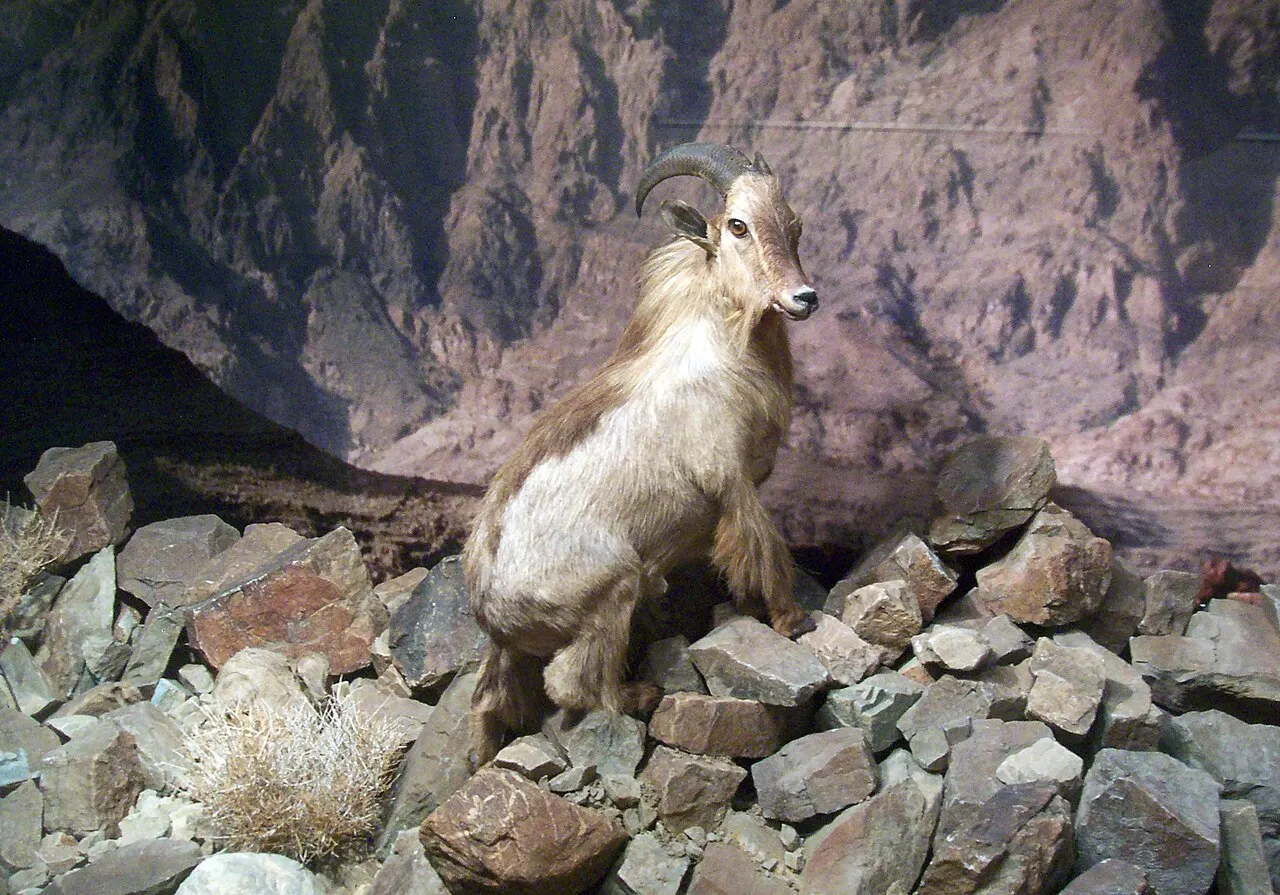
Endangered
Arabian tahr
Arabitragus jayakari
The Arabian tahr (Arabitragus jayakari) is a small, stocky wild goat relative that lives on steep, rocky slopes in the Hajar Mountains of Oman and the United Arab Emirates. The IUCN Red List rated it Endangered in 2019. Only about 2,200 mature animals remain, and they are scattered in patches.
How to recognise it
It is the smallest of the tahrs. The build is stocky, the coat is long and reddish brown, and a dark stripe runs down the back. Both sexes carry horns that sweep backward, though males are much more heavily built. Adult males grow a mane along the back that lengthens with age.
The hooves are rubbery, which gives grip on bare rock. It was first described in 1894 from specimens collected on Jebel Taw in Oman. A genetic study in 2005 led to its placement in a genus of its own, Arabitragus, apart from the Himalayan and Nilgiri tahrs.
Where it lives
The Hajar chain runs for about 650 km through northern Oman and the eastern UAE. The tahr is found only there, on rugged mountain ground in desert, dry shrubland and rocky terrain. The IUCN gives an elevation span of sea level to 2,315 m, but a camera-trap study found the most use at 800 to 1,000 m.
The range is smaller than the map of the mountains suggests. A study published in Oryx ran 333 camera traps between October 2012 and May 2015 and found tahr at 139 of 300 sites analysed. By its model, once areas where tahr have died out were removed, only 23.9 percent of the range, about 6,986 square km, was occupied.
Pins are Wikidata “endemic to” fields. Orange dots, when present, are GBIF occurrence tiles — survey bias included.
How it lives
Tahr are mostly solitary, or travel as a female with her kid. They browse on grasses, shrubs, leaves and tree fruits. In summer an animal needs to drink every two to three days, so it comes down to wadis. Births have been reported all year, and a gestation of roughly four and a half months has been described.
The Arabian leopard reportedly preyed on tahr in the past.
Why it is in trouble
The IUCN estimated 2,202 to 2,324 mature animals in 2019, split into badly fragmented groups, with the largest holding about 249. The trend is downward. Listed pressures include roads, mining and quarrying, grazing by livestock, hunting, groundwater pumping and drought.
Goats matter most. In the Oryx study, tahr were less likely to be present near villages and where more domestic goats were photographed. Each extra goat photographed per trap-night roughly halved the odds that tahr were present. Killing or capturing tahr has been illegal in Oman since 1976, but enforcement on steep ground is difficult, and the IUCN lists hunting among the pressures.
The United Arab Emirates side is far more precarious. The country's own 2018 assessment rated the tahr Critically Endangered there, with 10 to 12 animals in two isolated groups. Nine were camera-trapped on Jebel Hafeet in 2015. The last record in Wadi Wurayah National Park was a photo from October 2012, and animals were photographed in the Hatta enclave in 2017.
What is being done
Protection appears to help. In the Oryx study, 83.6 percent of camera traps inside protected areas recorded the animal, against 36.5 percent outside. The IUCN reports that 21 to 30 percent of the population is inside protected areas, a monitoring scheme is running and captive breeding is under way. The study recommended more reserves, keeping goats out of core habitat and releasing captive animals into empty suitable ground.
On Sir Bani Yas Island in Abu Dhabi, a small breeding group, acquired from a Sharjah wildlife centre, reached four animals in 2018 when a female calf was born. The aim is to return tahr to the wild eventually. A captive-breeding programme in Oman reportedly began in 1980.
Sources
Written for this catalog in our own words from the sources below, checked against them on 12 November 2026. Population figures are estimates and carry the year they were made. Status and assessment year: IUCN. 2026. The IUCN Red List of Threatened Species. Version 2026-1. iucnredlist.org.




