Endangered
Sokoke pipit
Anthus sokokensis
The Sokoke pipit (Anthus sokokensis) is a small, heavily streaked bird of the coastal forests of Kenya and Tanzania, about 12 cm long. It is best known from Arabuko-Sokoke Forest in Kenya. The IUCN Red List assessed it as Endangered in 2025, with numbers decreasing.
How to recognise it
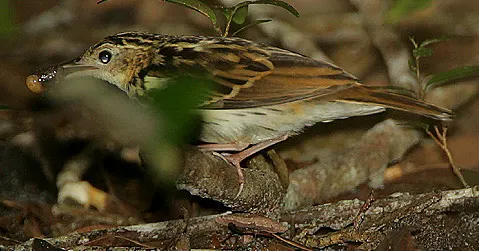
It is a drab brown pipit, about 12 cm long, with heavily streaked upperparts and pale wingbars. The underparts are creamy white with bold black streaking, strongest on the breast, and the legs are pale. Within its forest habitat no other pipit shares the ground with it. Its call is a distinct, far-carrying sweer or tsseeer. Victor van Someren described the species in 1921.
Where it lives
The species is a resident of coastal forest and woodland in Kenya and Tanzania, from sea level to around 400 m, in lowland moist and dry forest. It does not migrate. The Red List counts 10 to 30 locations and records it in at least one protected area. It is best known from Arabuko-Sokoke Forest on Kenya's coast.
Within that forest it uses Brachystegia woodland. A survey from November 2011 to February 2012 by Otieno and colleagues, published in 2014, found more birds where the forest floor was covered in deep leaf litter, and fewer where logging had been heavier.
Pins are Wikidata “endemic to” fields. Orange dots, when present, are GBIF occurrence tiles — survey bias included.
Numbers
The 2025 assessment estimates 2,500 to 9,999 individuals and a declining population. Earlier work in Arabuko-Sokoke, by Musila and colleagues, had put that forest at about 13,000 birds, with density around 2.8 per hectare in undisturbed forest and 0.7 to 0.9 per hectare in disturbed areas.
The 2014 survey of three Brachystegia blocks found an average of 0.72 birds per hectare and estimated about 5,500 birds there, with a wide margin of error (roughly 3,200 to 9,100). Otieno and colleagues linked the lower figure to continued habitat loss, mainly tree removal. It was a small survey, with only 17 encounters, and a reviewer questioned how reliable the estimates were.
Why it is in trouble
The assessment lists small-holder farming and grazing, the unintended effects of harvesting (at subsistence and larger scales), fire, housing, and problem native species or disease as ongoing pressures. The 2014 survey tied logging directly to lower pipit density.
Habitat loss runs through all of it. A bird that works the leafy forest floor does badly when trees are removed and the litter thins out.
What is being done
The assessment records that conservation sites are identified over the whole range. It lists site protection, habitat protection, site management and awareness work as actions needed. It also records no recovery plan, no systematic monitoring scheme, no education programme and no captive population.
Sources
Written for this catalog in our own words from the sources below, checked against them on 12 November 2026. Population figures are estimates and carry the year they were made. Status and assessment year: IUCN. 2026. The IUCN Red List of Threatened Species. Version 2026-1. iucnredlist.org.




