Endangered
Retowski's Tonged Bush-cricket
Anadrymadusa retowskii
Retowski's tonged bush-cricket (Anadrymadusa retowskii) is a light brown, short-winged katydid found only on the sunny rocky slopes of Crimea's southern coast. It is listed as Endangered on the Red List (assessed 2016), with a small range under pressure from housing and tourism.
How to recognise it
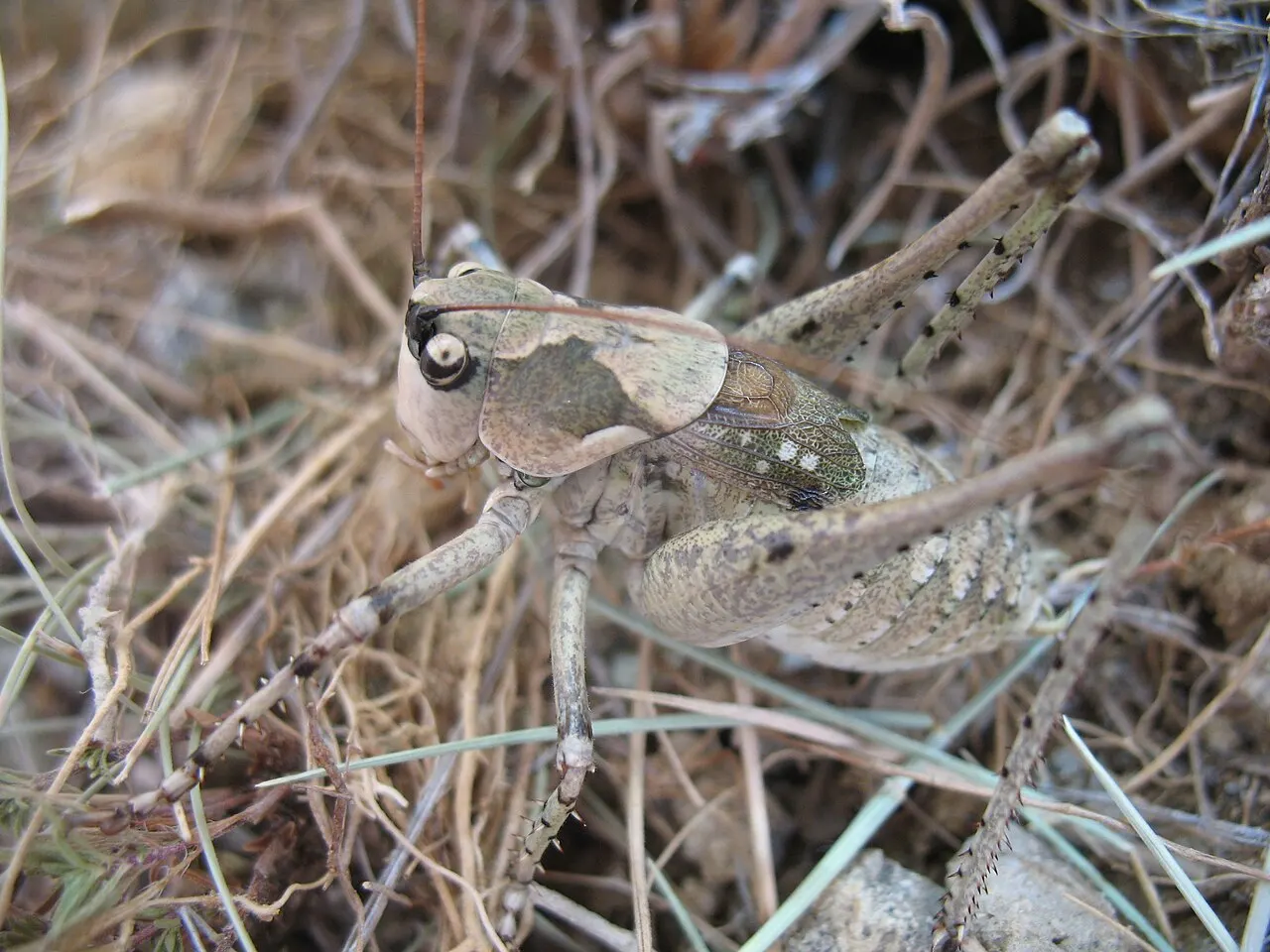
It is a short-winged bush-cricket, light brown overall, with brown forewings that are sometimes tinted green. The forewings extend just beyond the cylindrical pronotum (the shield behind the head). The pronotum carries two dark spots on its sides, and the thread-like antennae are uniformly brown and longer than the body.
Females measure roughly 31 to 36 mm without the ovipositor, and the saber-shaped egg-laying tube adds another 25 to 27 mm. A second reference gives female lengths up to 40 mm and male lengths of 28 to 36 mm, so published sizes vary a little.
Where it lives
The species is endemic to the southern coast of Crimea. It is the only member of its genus recorded in Ukraine. The Red List estimates its extent of occurrence at about 2,902 square kilometres, but the area it actually occupies is much smaller, between 50 and 200 square kilometres, from near sea level up to about 200 m.
Its habitats are listed as temperate shrubland, temperate grassland and rocky ground. Ukrainian accounts describe dry, sun-warmed steppe and shallow, water-cut ravines on south-facing slopes at roughly 100 to 200 m, with squirting cucumber plants among the vegetation. It has reportedly been found near Alupka and Alushta and on rocky slopes in the Karadag Nature Reserve. GBIF holds human observations from Crimea in most years between 2010 and 2022, so it is still being seen.
Pins are Wikidata “endemic to” fields. Orange dots, when present, are GBIF occurrence tiles — survey bias included.
How it lives
It has one generation a year. Eggs pass the winter, the young appear in spring, and adults are found from mid-July to early September. The Red Book of Ukraine says only isolated individuals are recorded, and that no information exists on breeding it in captivity.
Why it is in trouble
The Red List records a declining population and names housing and urban development and tourism and recreation areas as the threats. The Red Book of Ukraine, which rates the species Vulnerable nationally, puts the decline down to excessive recreational pressure on its habitat.
The species was first described in 1907 from collections made in southern Crimea between 1897 and 1905.
What is being done
The Red List records resource and habitat protection and site protection as actions in place, and notes that the species occurs in at least one protected area. It is protected in the Karadag Nature Reserve, and the Red Book entry recommends setting up entomological reserves where it lives. No species-specific recovery programme is described.
Sources
Written for this catalog in our own words from the sources below, checked against them on 12 November 2026. Population figures are estimates and carry the year they were made. Status and assessment year: IUCN. 2026. The IUCN Red List of Threatened Species. Version 2026-1. iucnredlist.org.




