Critically Endangered
Amastra rubens
Amastra rubens
Amastra rubens is a small land snail found only in the Hawaiian Islands, with records from Oahu. Its shell is straw-colored with a rosy lip. The IUCN Red List has rated it Critically Endangered since a 1996 assessment, and almost nothing has been published about its living populations.
How to recognise it
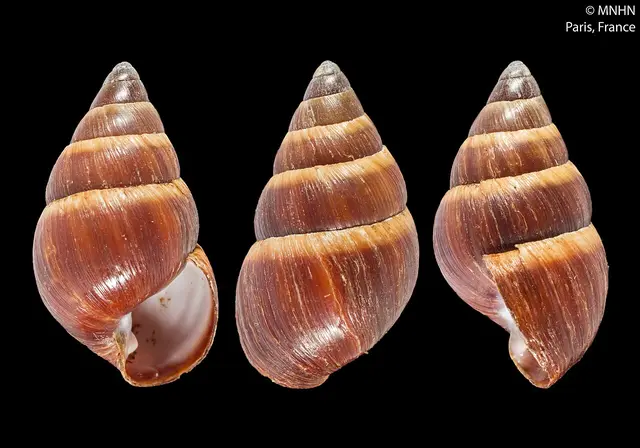
The shell is elongate and egg-shaped, up to about 19 millimetres long and 9 millimetres wide, with roughly six and a third whorls. Its outer surface is straw-colored, the tip is chestnut and the front of the shell shades toward red. The outer layer is often worn away, which leaves a darker brown surface underneath.
The lip of the opening is thick and tinted pink or rose. The inner surfaces of the lip are usually rose-colored, occasionally bluish-white, and the throat is white. The body of the living animal is dark slate with black tentacles, and it is described as highly timid.
Where it lives
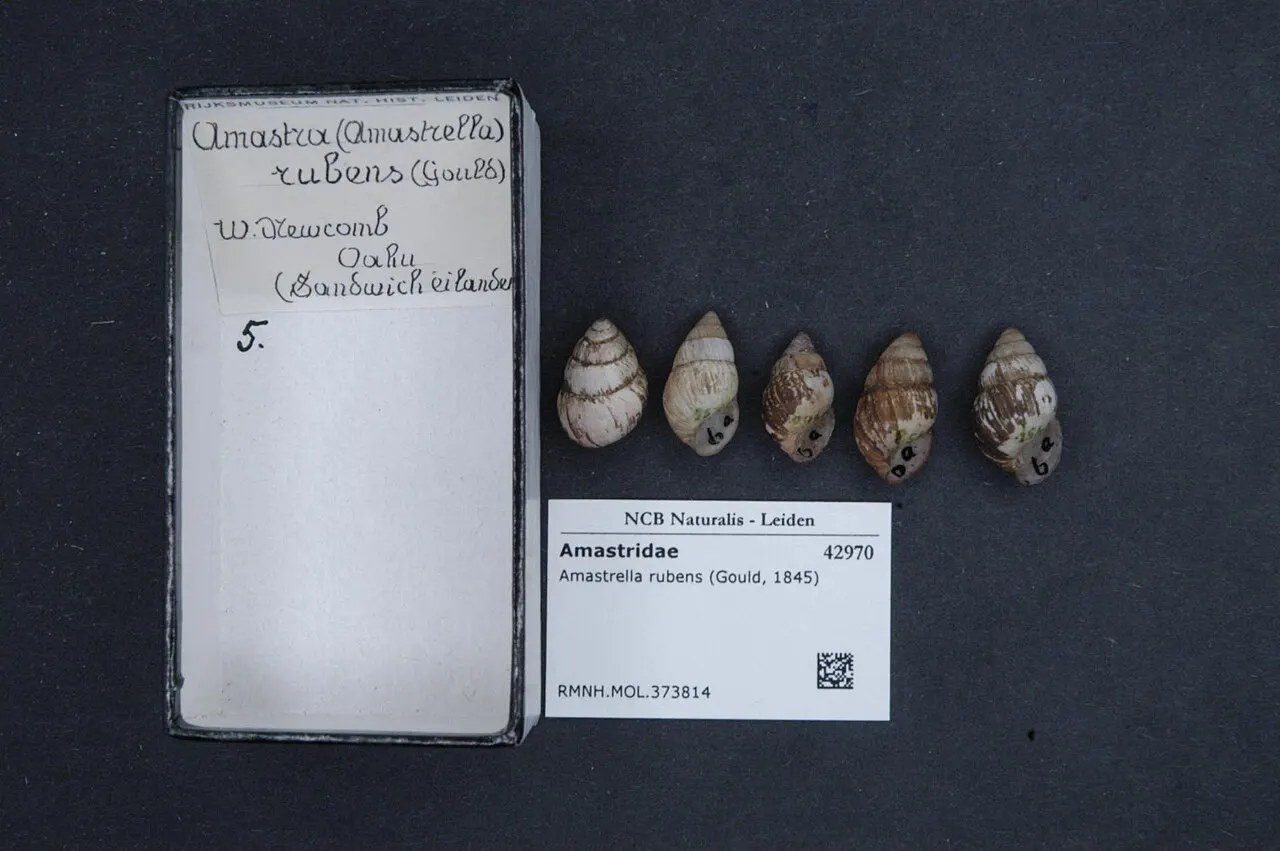
John Gould described the species in 1845 under the name Achatinella rubens, and it now sits in the genus Amastra, a group found nowhere outside Hawaii. Six subspecies have been named, five of them by Hyatt and Pilsbry in 1911, so shells vary in color and form.
The Red List records it from the Hawaiian Islands in the United States, and published accounts place it on Oahu. It lives buried under leaves and decaying plant matter. Amastra snails as a group once lived in wet and moderately wet forest.
Pins are Wikidata “endemic to” fields. Orange dots, when present, are GBIF occurrence tiles — survey bias included.
Why it is in trouble
The 1996 assessment used criteria B1+2abd, which describe a small range that is shrinking in extent, occupied area and habitat quality. The record lists no population size, population trend or threat details, so the exact numbers are simply not known.
What is known comes from the wider story of Hawaii's land snails. The islands once held at least 750 native species, and a 2026 review in Philosophical Transactions of the Royal Society B, led by Robert Cowie, reports estimates that only 10 to 35 percent of that diversity survives. Habitat loss started the decline. Rats and introduced predators, including the rosy wolfsnail and the New Guinea flatworm, are probably the ultimate cause of many extinctions.
The rosy wolfsnail was brought from Florida in the hope it would eat the giant African land snail, which damaged crops. David Sischo, who coordinates Hawaii's state snail program, says nearly all recent disappearances of native snails coincide with the wolfsnail showing up in new areas.
What is being done
No action specific to Amastra rubens appears in the Red List record. Hawaii's Snail Extinction Prevention Program, part of the state Department of Land and Natural Resources, surveys known populations, controls predators with measures such as predator-proof fences, and breeds threatened snails in a lab. Some surviving Amastra species have been collected for captive breeding at the Bishop Museum and by that program. The 2026 review describes captive breeding as buying time for these ancient lineages.
Sources
Written for this catalog in our own words from the sources below, checked against them on 12 November 2026. Population figures are estimates and carry the year they were made. Status and assessment year: IUCN. 2026. The IUCN Red List of Threatened Species. Version 2026-1. iucnredlist.org.