Critically Endangered
Alycaeus balingensis
Alycaeus balingensis
Alycaeus balingensis, now placed in the genus Stomacosmethis, is a tiny land snail from the limestone hills of northern Peninsular Malaysia, with a shell roughly 5 to 6 mm across. The IUCN Red List rated it Critically Endangered in 2009, when only one quarried hill was known, though later surveys found more sites.
How to recognise it
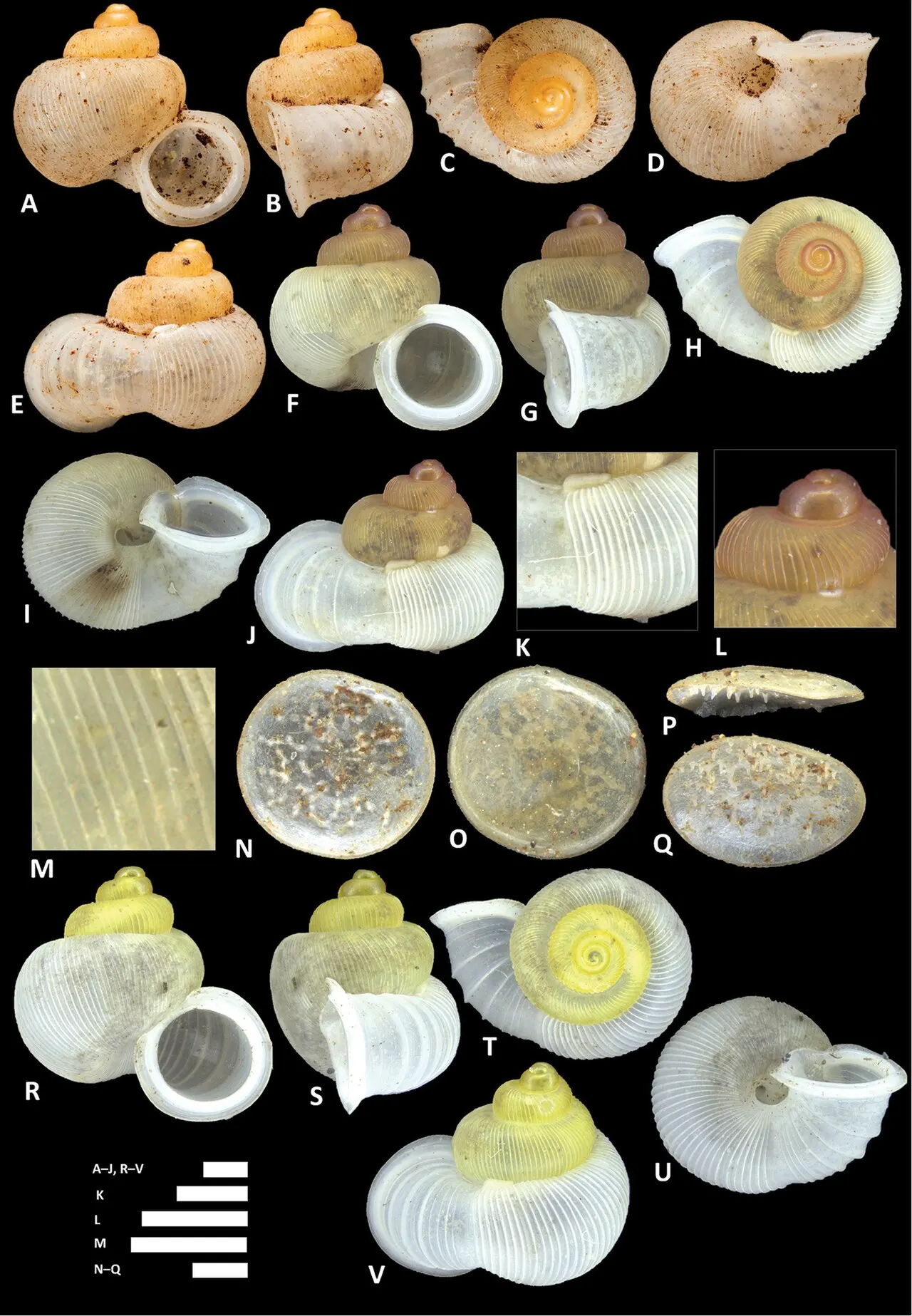
This is a snail you would need to look at closely. The shell is rounded, about as wide as it is tall, with measured heights of 4.75 to 5.87 mm and widths of 5.11 to 6.00 mm. It has up to just over four whorls, an open navel (umbilicus) and a circular mouth with a double rim.
The surface carries pronounced, evenly spaced ribs, and there are no spiral lines. The tip of the shell can be red, yellow or white, and every colour fades to white toward the last whorl. The living animal has a greenish-black body and head, with green tentacles tipped in brown.
The lid that closes the shell (the operculum) is covered on the outside by a chalky layer with short spikes. That, along with the denser ribbing and the dark body, separates it from two similar Malaysian relatives, Alycaeus liratulus and Alycaeus thieroti.
Where it lives
Tomlin described the species in 1948 from specimens collected by M. W. F. Tweedie at Bukit Baling in Kedah in December 1938, and called it rather common there. For decades it was known from that single limestone hill. The IUCN lists it from Malaysia only.
A 2017 review of the genus Alycaeus in Peninsular Malaysia, by Foon and Liew, reported more sites. The species is restricted to northern Perak and northeastern Kedah, with records from Bukit Baling, Gunung Pulai in Kedah, and a hill near Tasik Temenggor in Perak.
Pins are Wikidata “endemic to” fields. Orange dots, when present, are GBIF occurrence tiles — survey bias included.
How it lives
It lives in crevices on wet limestone boulders and on shrubs close to the ground, in forested areas of limestone hills. The IUCN lists its habitat as tropical moist lowland forest.
Its diet, breeding and lifespan have not been described in the sources available.
Why it is in trouble
Limestone hills are mined for cement and building stone, and a quarried hill cannot be put back. The 2009 assessment gave mining and quarrying as the main threat, affecting the whole known population, and recorded one location, a decreasing population and continuing loss of habitat. It was rated Critically Endangered under criteria B1ab(iii)+2ab(iii), which concern a very small range with a shrinking habitat.
Foon and Liew's 2017 review found populations at two further sites, in Kedah and Perak, and concluded that the Red List status should be revised. The most recent assessment on record is still the 2009 one.
What is being done
The IUCN assessment lists no conservation actions in place for the species. Its prospects depend largely on whether the limestone hills where it lives are left unquarried.
Sources
Written for this catalog in our own words from the sources below, checked against them on 12 November 2026. Population figures are estimates and carry the year they were made. Status and assessment year: IUCN. 2026. The IUCN Red List of Threatened Species. Version 2026-1. iucnredlist.org.




