Endangered
Alpine woolly rat
Mallomys gunung
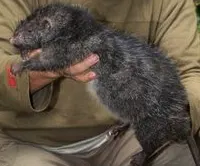
The alpine woolly rat (Mallomys gunung) is a rat the size of a small cat that lives above the tree line in the high mountains of Indonesian New Guinea. It is known from only two places. The IUCN Red List rated it Endangered in 2016, with a declining population.
How to recognise it
This is a very big rodent. Head and body together measure about 415 to 470 mm, the tail adds another 355 to 368 mm, and an adult weighs around 2 kg. The fur is long and woolly. The tail is fairly short for a giant rat, about four fifths of the head and body length.
Several details separate it from other woolly rats in its genus. The feet are blackish with long black and white hairs and long, slender claws, and the front teeth have white enamel instead of the orange enamel of its relatives. Females have three pairs of teats.
Where it lives
It is found only in Indonesia, in the Central Range of western New Guinea. The type specimen came from about 2 km east of Mount Wilhelmina at 3,800 m, and the species was described in 1989. The IUCN counts two localities, between the Mount Wilhelmina and Mount Carstensz areas, and says it may occur at others. Part of its range lies inside Lorentz National Park.
It lives on alpine grassland and bare, rocky ground above the tree line, between about 3,500 and 4,050 m.
Pins are Wikidata “endemic to” fields. Orange dots, when present, are GBIF occurrence tiles — survey bias included.
How it lives
It lives on the ground and shelters in dens among rocks. It is probably active at night. Almost nothing else has been recorded. Its food, movements, home range and social life are undocumented, though other woolly rats are thought to eat mostly plant material.
Females in museum collections were reportedly pregnant with a single young, so it probably has one offspring at a time. The IUCN thinks it breeds slowly, and puts its generation length at about 1.7 years.
Why it is in trouble
The IUCN rated it Endangered because it lives only at high elevations, its extent of occurrence is under 5,000 square kilometres, and it is known from two localities, with continuing decline in habitat and numbers. It lists hunting for human food as a use, and predation by wild dogs is also reported. Slow breeding makes losses harder to recover from.
Fire is a growing worry. Warming is expected to increase the frequency of fires on the high mountains and to shrink the habitat. Fossil remains from the last 10,000 or so years (the Holocene) are abundant, showing the species was once far more common, so its present range is a remnant.
What is being done
Conservation sites have been identified across its whole range, and it occurs in at least one protected area. The IUCN lists no conservation actions specific to the species. Research on its population size, distribution and trends, its ecology and its threats is listed as needed.
Sources
Written for this catalog in our own words from the sources below, checked against them on 12 November 2026. Population figures are estimates and carry the year they were made. Status and assessment year: IUCN. 2026. The IUCN Red List of Threatened Species. Version 2026-1. iucnredlist.org.




