Endangered
Yucatán black howler
Alouatta pigra
The Yucatán black howler (Alouatta pigra) is the largest of the howler monkeys, living in forests of southeastern Mexico, northern Guatemala and Belize. The IUCN Red List lists it as Endangered (assessed 2020) and its numbers are falling under pressure from forest loss, hunting and capture for the pet trade. Males roar at dawn and dusk.
How to recognise it
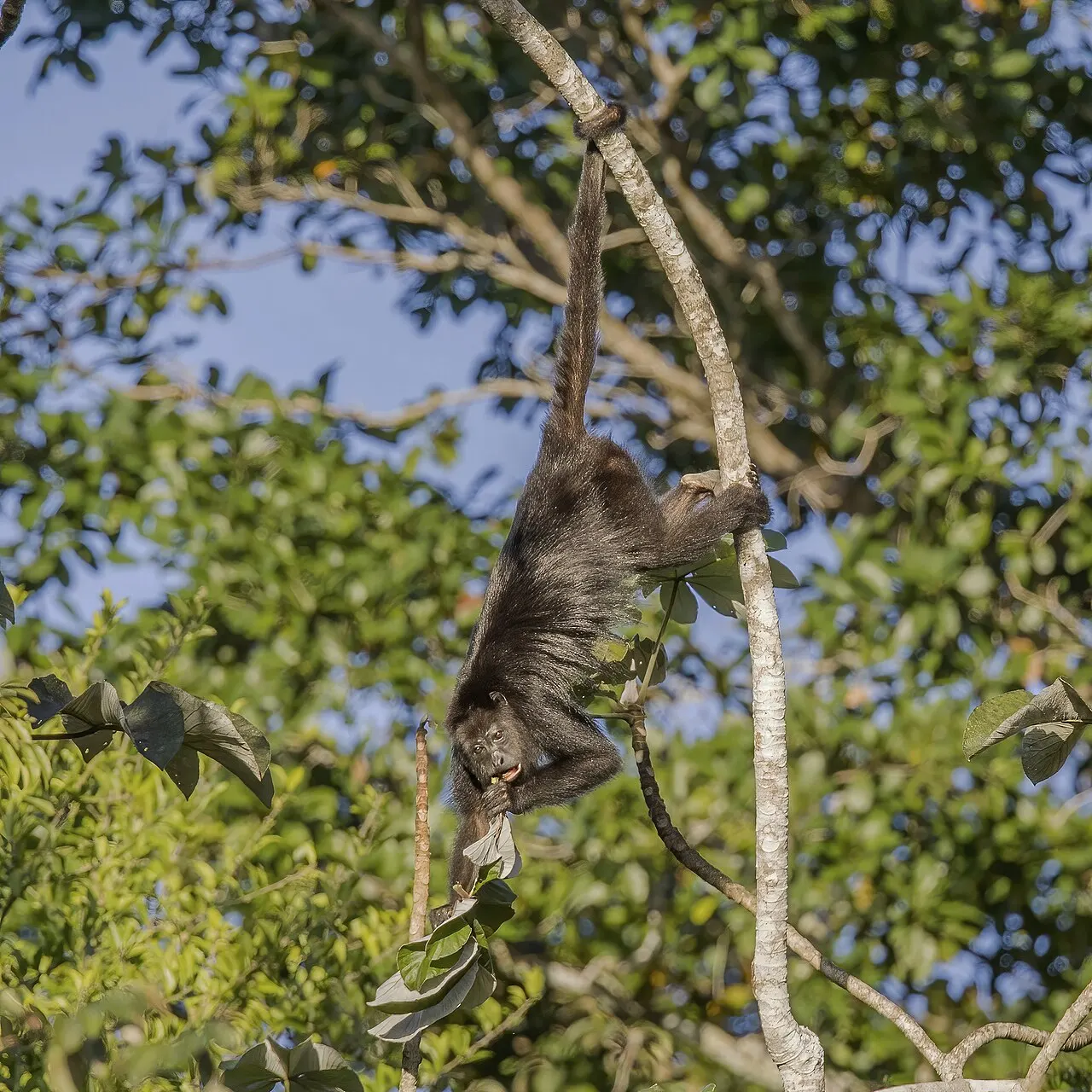
Adults are black, with a prehensile tail that is slightly longer than the body, which is about 70 cm. This is the most sexually dimorphic howler: males average about 11.4 kg and females about 6.4 kg. Young animals keep pale fur for the first 9 to 10 weeks or so. In Belize, where people call it the baboon, the name is said to come from early African arrivals who saw a likeness to monkeys they knew at home. It is not related to the baboons of Africa.
The loud call comes from males, whose enlarged hyoid bone amplifies their roars. They are mostly heard at dawn and dusk, and a howl can reach about 88 decibels at 5 metres.
Where it lives
Its range covers Belize, northern Guatemala and the Mexican states of Quintana Roo, Campeche, Chiapas, Tabasco and Yucatán. It is the only howler monkey on the Yucatán Peninsula. The IUCN lists its habitat as moist lowland, dry, moist montane and swamp forest, plus mangroves above the high-tide line. Most records are below 400 metres, though some groups live above 500 metres.
It prefers larger trees in the middle to upper canopy and does less well in areas disturbed by people. Along parts of its range edges in Mexico and Guatemala, it overlaps with the mantled howler.
Pins are Wikidata “endemic to” fields. Orange dots, when present, are GBIF occurrence tiles — survey bias included.
How it lives
Black howlers eat leaves, fruit and flowers. One breakdown of the diet gives roughly 36 percent fruit, 30 percent mature leaves, 25 percent new leaves and buds, and 5 percent flowers. They are among the more fruit-eating howlers and help spread seeds. Breadnut can supply up to 86 percent of the diet in some seasons.
Roughly 70 percent of the day is spent resting. Estimates of group size differ: 2 to 10 animals in one account, 4 to 11 in another, about 6 on average in a third. Groups usually hold one to a few adult males, with slightly more females than males. Young of both sexes often leave the group they were born in. A female typically has one baby a year after about 180 days of pregnancy, and individuals can live to about 20 years in the wild.
Why it is in trouble
The Red List assessment (2020) uses criterion A4cd, a decline driven by shrinking habitat and exploitation, with a generation counted as 10 years. The IUCN records the population as decreasing and enters an ongoing reduction of 50 percent. Other sources project 60 percent or 74 percent over about three decades.
Listed pressures include clearing for farms and ranches, housing and urban areas, hunting and capture, with the IUCN noting use as food and as pets or display animals. Storms are also listed. Hurricane Iris, in October 2001, damaged a forest fragment at Monkey River in southern Belize, and a 2013 study of its howlers records a loss of nearly 80 percent of the population within three years. Numbers stabilised in late 2004 and began to recover. Changes in density were linked mainly to how much fruit the monkeys could eat, with stress and parasites adding to the strain.
What is being done
The species is on CITES Appendix I. The IUCN records conservation sites identified across its whole range, presence in at least one protected area, and animals held in captivity, and lists site management and harvest management as the actions needed.
In Belize, the Community Baboon Sanctuary reports that its howlers grew from about 450 to about 4,500. Black howlers once disappeared from Cockscomb Basin Wildlife Sanctuary and were later translocated there. A survey by the Wildlife Conservation Society's Queens Zoo describes the monkeys as thriving across the reserve.
Sources
Written for this catalog in our own words from the sources below, checked against them on 12 November 2026. Population figures are estimates and carry the year they were made. Status and assessment year: IUCN. 2026. The IUCN Red List of Threatened Species. Version 2026-1. iucnredlist.org.




