Endangered
White-fronted ground dove
Alopecoenas kubaryi
The Caroline Islands ground dove, also called the white-fronted ground dove (Pampusana kubaryi), is a shy forest dove found only in the Federated States of Micronesia. The IUCN Red List assessed it as Endangered in 2020, with an estimated 200 to 500 mature birds and a population still falling.
How to recognise it
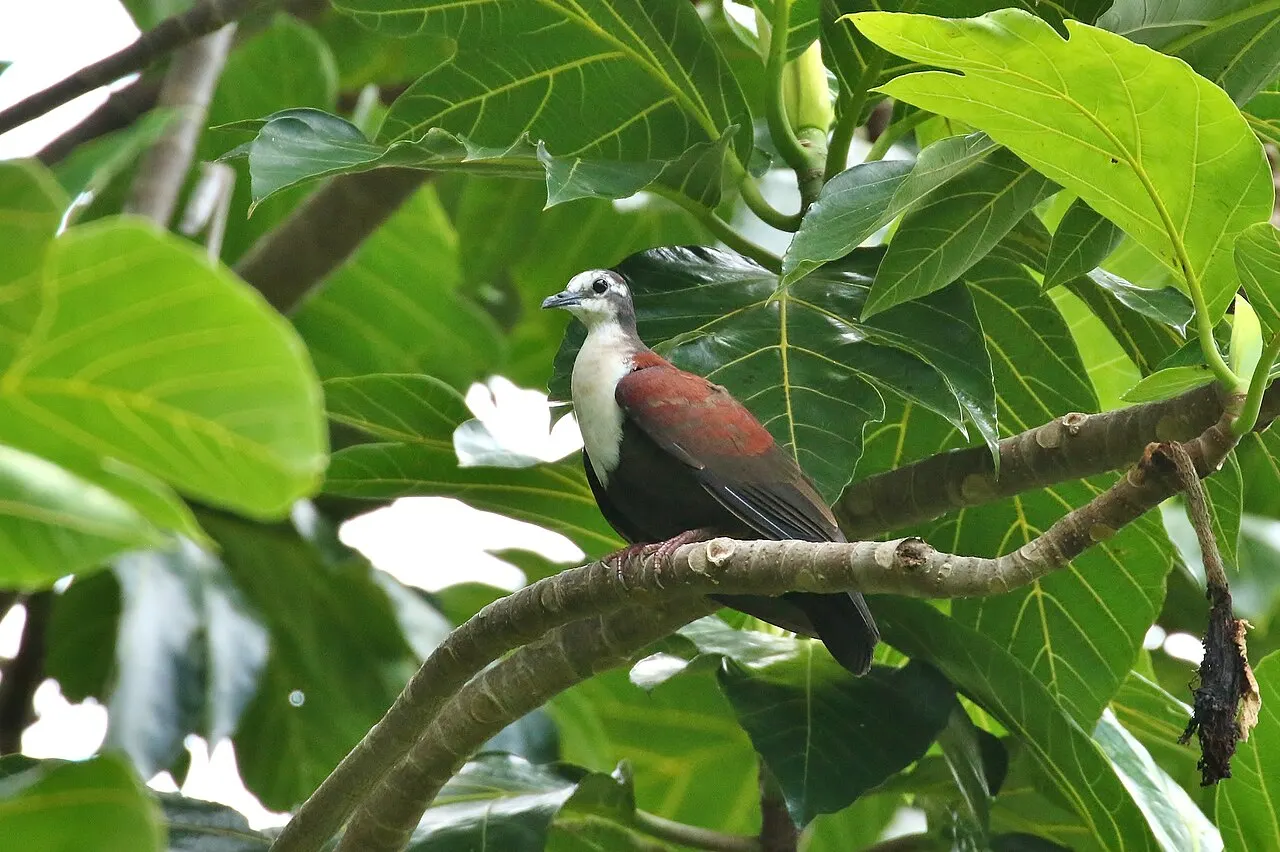
It is a medium-sized, short-tailed dove about 28 centimetres long. Adults have a white head and breast, set off by a black crown and a dark stripe behind the eye. The back and shoulders are purplish crimson, and the hind part of the body is mostly black. Young birds are dark rusty brown. Its call is a low moan that is rarely heard.
Where it lives
The species is endemic to Micronesia and is found on Pohnpei and in Chuuk. The IUCN counts 6 to 10 locations and two subpopulations, with an estimated extent of occurrence of about 30,000 square kilometres, most of it ocean. It uses moist lowland and mountain forest, mangrove forest above the high-tide line, moist shrubland and plantations.
It is shy and usually stays in forest, though it also turns up in gardens at middle elevations in Chuuk and is partial to mangroves on Pohnpei.
Otto Finsch described it in 1880 as Phlegoenas kubaryi. It was later placed in Alopecoenas, and in 2019 the genus name changed to Pampusana because that name has priority. Some databases still use the older name.
Pins are Wikidata “endemic to” fields. Orange dots, when present, are GBIF occurrence tiles — survey bias included.
How many are left
Surveys show a long decline. On Pohnpei, a 1983 to 1984 survey estimated 841 birds. A repeat survey in 1994 found about half as many, and a 2012 survey at 247 stations recorded only five. In Chuuk the 1983 to 1984 estimate was 294, and a 2001 estimate was significantly lower.
The current Red List figure of 200 to 500 mature birds is an estimate built from those surveys. The assessment suspects a reduction of 30 to 49 percent over the past three generations (about 18 years), with a similar rate expected to continue.
Why it is in trouble
The assessment lists several ongoing pressures. Small-holder farming reduces forest, and introduced cats, Polynesian rats and black rats are named as predators. The brown tree snake is listed as a future threat that has not yet arrived. The doves are also hunted, and the assessment records use as human food at local level.
What is being done
Conservation sites have been identified across its whole range, and it occurs in at least one protected area. There is no recovery plan, no systematic monitoring scheme, no invasive species control, no captive population and no recent education programme.
The assessment lists site and area protection and control of invasive species as needed actions.
Sources
Written for this catalog in our own words from the sources below, checked against them on 12 November 2026. Population figures are estimates and carry the year they were made. Status and assessment year: IUCN. 2026. The IUCN Red List of Threatened Species. Version 2026-1. iucnredlist.org.




