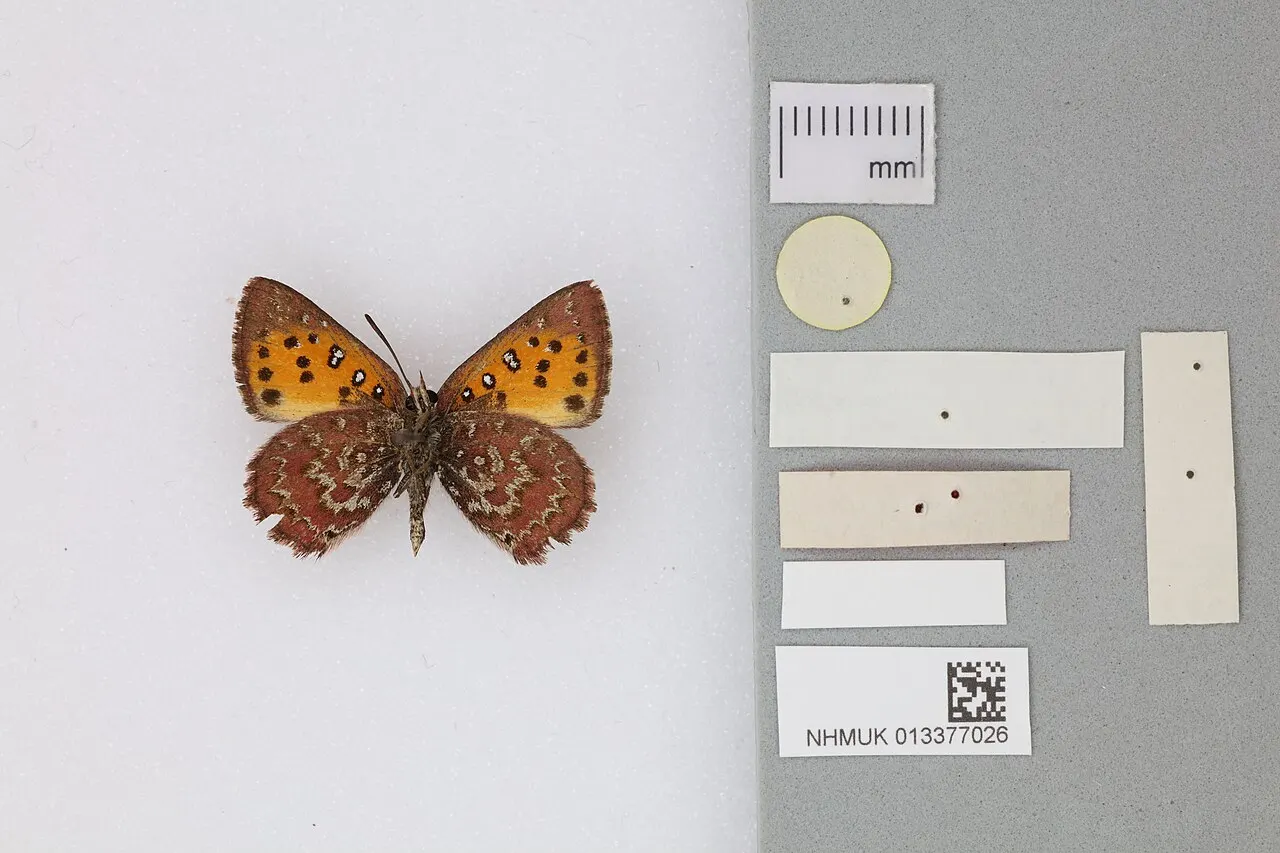
Critically Endangered
Aloeides rossouwi
Aloeides rossouwi
Rossouw's copper (Aloeides rossouwi) is a small butterfly that lives only on mountain grassland near Stoffberg in Mpumalanga, South Africa. The IUCN Red List assessed it as Critically Endangered in 2020. Only one colony is known, estimated at 51 to 249 individuals.
How to recognise it
It is a copper, a small butterfly in the family Lycaenidae. Males have a wingspan of 22 to 26 mm and females 24 to 28 mm. It was described by Henning and Henning in 1982 from Stoffberg. Don't confuse it with the unrelated Thestor rossouwi or Lepidochrysops rossouwi, which share the name but are different butterflies.
Where it lives
The butterfly is endemic to South Africa. Adults have been found flying in rocky gullies at about 1,800 m on the escarpment south-west of Stoffberg, in Sekhukhune Montane Grassland, where rainfall is high and frost comes and goes. The 2009 Red Data Book described it as known from a single peak. The Red List gives a range of about 8 square km, a single location, and a single subpopulation holding every known individual.
Pins are Wikidata “endemic to” fields. Orange dots, when present, are GBIF occurrence tiles — survey bias included.
How it lives
Adults fly energetically over short distances and settle on rocks or open soil, and males occasionally hilltop. Reports differ on when they fly: one account gives September to November and February to March, with two generations a year, while the 2009 Red Data Book records adults from October to February.
Like many coppers, the larvae are associated with ants, in this case of the genus Lepisiota. Nobody has recorded what the caterpillars eat; the larval food plant was still unknown in 2009.
Why it is in trouble
Several colonies once existed around Stoffberg, but some became overgrown by invasive alien plants and secondary vegetation because the grassland was no longer burned, and the butterfly can no longer live in them. By 2009 the survivor was a small colony in a quarry, with early-stage plants, next to a spreading stand of black wattle.
The 2020 assessment lists nomadic grazing, fires that are too frequent or too rare, and other changes to the ecosystem, and says the population is declining. The 2009 Red Data Book rated it Endangered; by 2020 it was Critically Endangered.
What is being done
In 2009 the Red Data Book reported no conservation measures in force. It called for regular monitoring of population and habitat, removing alien trees in and around the site, setting up a suitable fire regime and management plan, and studies of its basic ecology. The 2020 assessment lists site management and control of invasive species as the needed actions, with none recorded as in place.
Sources
Written for this catalog in our own words from the sources below, checked against them on 12 November 2026. Population figures are estimates and carry the year they were made. Status and assessment year: IUCN. 2026. The IUCN Red List of Threatened Species. Version 2026-1. iucnredlist.org.




