Critically Endangered
Alabama sturgeon
Scaphirhynchus suttkusi
Alabama sturgeon is a ray-finned fish in the family Acipenseridae (order Acipenseriformes) — Scaphirhynchus suttkusi, recorded as Critically Endangered.
Appearance
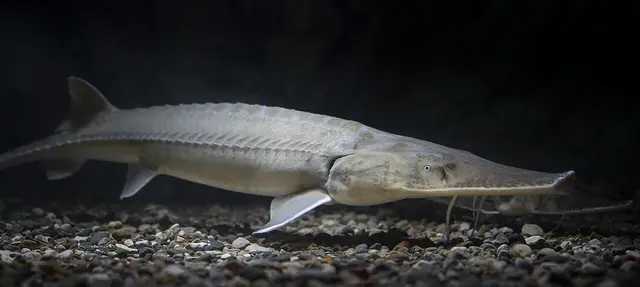
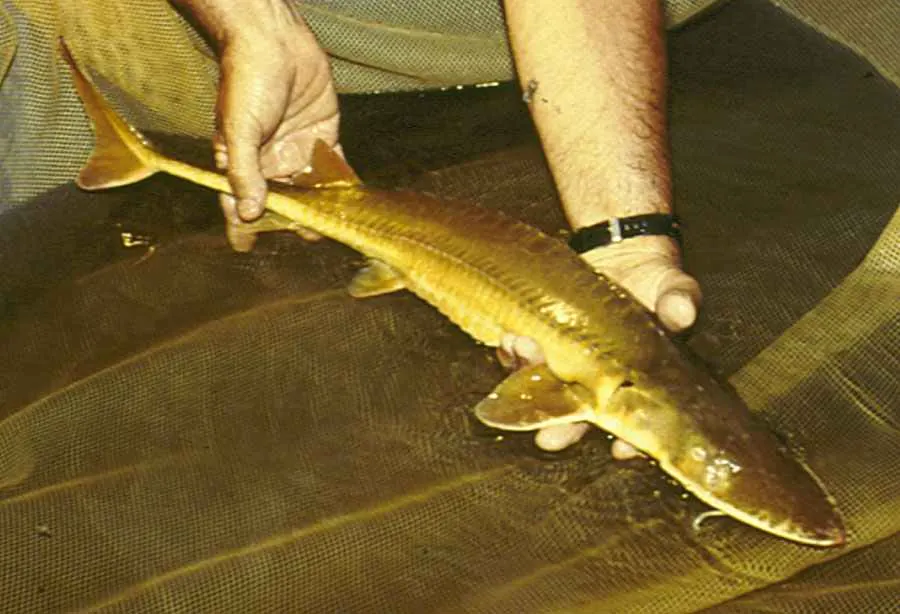
The Alabama sturgeon has an elongated, flat snout and a shark-like tail. It has a distinct brownish-orange color on its back and fins, golden yellow sides, and a cream-colored belly. Alabama sturgeons have fan-shaped gill rakers made of bone or cartilage projecting from their gill arches.
Its orbit, the space where the eye is positioned, at 16 mm long is wider than those of other sturgeons. The fish has a distinctive yellowish-orange color, grows to a size of about 30 in (76 cm) long and 2 to 3 lb (0.9–1.4 kg), and is believed to have a lifespan of 12 to 20 years.
Range and habitat
The Alabama sturgeon is a sturgeon native to the United States of America and now only believed to exist in 130 miles (210 km) of the lower Alabama River. Its historical ranges were believed to be over 1,600 kilometres (990 mi) of river and included the Alabama, Tombigbee, Mobile, Tensaw, Black Warrior, Cahaba, Coosa, and Tallapoosa rivers.
Pins are Wikidata “endemic to” fields. Orange dots, when present, are GBIF occurrence tiles — survey bias included.
Diet and breeding
The diet of Alabama sturgeon consists of aquatic insects and fish. Fish make up roughly 1/3 of their diet, among them those from the orders Cypriniformes (minnows, shiners, logperch) and Perciformes (darters, bluegills).
Sexual maturation likely occurs between 5 and 7 years of age, and they likely spawn once every 2–3 years. One artificial propagation experiment yielded the harvest of 4000 mature eggs from an Alabama sturgeon, but wild sturgeons tend to experience multiple spawning events, so the true number may be higher.
In crisis
CITES lists this taxon on Appendix II. Confirm the current appendix on the CITES checklist.
Alabama sturgeon is Critically Endangered on the IUCN Red List (assessed 2022, criteria A2bce; C2a(i,ii); D). Confirm the official criteria and any later count on the assessment page.
Sources
Adapted from the English Wikipedia article on Alabama sturgeon (CC BY-SA 4.0; authors are listed in the article history; changes were made), Wikidata item Q2123132. Family and order context is original field-guide writing about the group, not a copied assessment of this one species. Not an IUCN assessment. Counts, when quoted, can change — confirm them on the recovery programme and on iucnredlist.org. Status and assessment year: IUCN. 2026. The IUCN Red List of Threatened Species. Version 2026-1. iucnredlist.org.