Critically Endangered
Alabama cavefish
Speoplatyrhinus poulsoni
The Alabama cavefish (Speoplatyrhinus poulsoni) is a pale, eyeless fish known only from underground pools in Key Cave, in northwestern Alabama. The IUCN Red List rated it Critically Endangered in 2013. Scientists estimate fewer than 100 remain.
How to recognise it
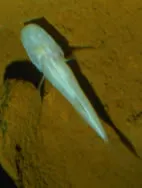
It's a small fish, with adults averaging about 30 to 60 mm long (one source gives about 72 mm). It has no eyes and almost no pigment, so it looks pinkish white with a faint bluish tint. The head is long and flattened, and the fins are translucent. Ridges of sensory papillae on the head and sides pick up vibrations, water pressure and temperature changes in total darkness.
Where it lives
The species is known only from five underground pools in Key Cave, Lauderdale County, now part of the Key Cave National Wildlife Refuge. John Cooper found it there in 1967, and he and Robert Kuehne described it in 1974. Searches of about 120 other caves since 1977 have reportedly turned up no other population.
The IUCN lists its habitat as karst and other underground water systems and its population trend as stable.
Pins are Wikidata “endemic to” fields. Orange dots, when present, are GBIF occurrence tiles — survey bias included.
How it lives
Its food chain runs on bat droppings. Gray bat guano feeds small crustaceans such as copepods, isopods and amphipods, and the cavefish eats them. It will also take mites, spiders and insects that fall into the water.
Breeding is poorly understood. Scientists have speculated that it reproduces more slowly than any other cave-dwelling aquatic species, perhaps not every year, with seasonal flooding as a possible trigger. It likely carries eggs or young in its mouth, as the northern cavefish does, but that has not been observed. Predicted lifespan is 5 to 10 years.
Why it is in trouble
Counts are tiny. Across 36 visits between 1967 and 1998, no more than 10 fish were seen on any visit and the average was under 4, according to one account. Only nine specimens have been collected, all before 1983.
The IUCN assessment lists groundwater extraction, sewage, fertiliser and pesticide run-off, erosion and sediment, recreation and effects from two named species. The 2019 recovery plan amendment adds stormwater run-off and nearby urban development as pressures on water quality. Fewer gray bats would mean less guano feeding the cave, and white-nose syndrome threatens the bats.
What is being done
The U.S. listed the fish as threatened in 1977 and reclassified it as endangered in 1988. The recovery plan dates from 1990. A 2019 amendment says downlisting needs a stable Key Cave population plus two more populations found or established, with their recharge areas protected. The Tennessee Valley Authority reportedly fenced the cave entrances to limit disturbance.
The Key Cave refuge was established in 1997 to protect the cave system and its shared aquifer, and the cave is closed to the public. The IUCN also records habitat protection and species recovery among its conservation actions.
Sources
Written for this catalog in our own words from the sources below, checked against them on 12 November 2026. Population figures are estimates and carry the year they were made. Status and assessment year: IUCN. 2026. The IUCN Red List of Threatened Species. Version 2026-1. iucnredlist.org.




