Endangered
Alabama cave shrimp
Palaemonias alabamae
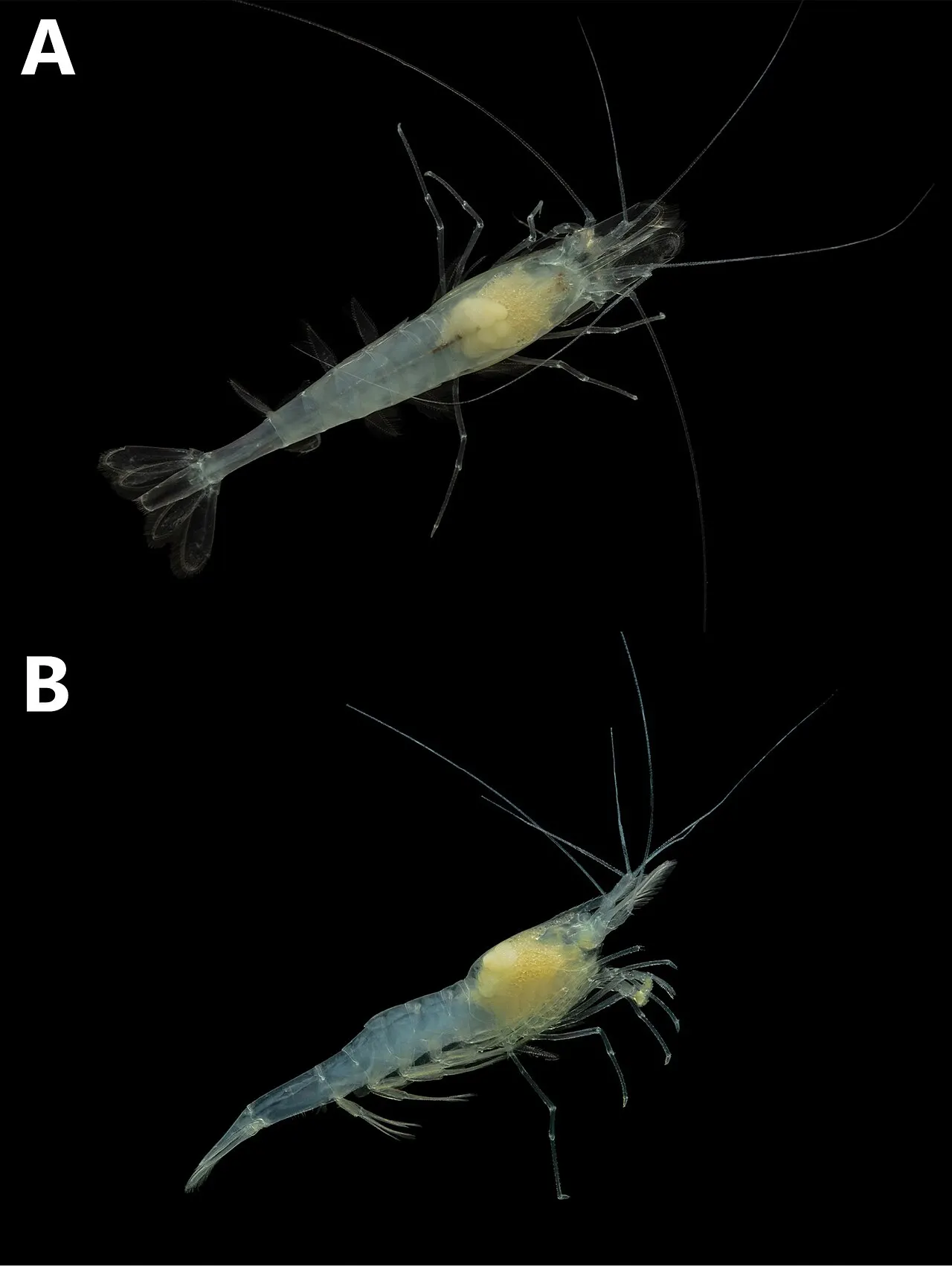
The Alabama cave shrimp (Palaemonias alabamae) is a tiny, see-through, nearly eyeless shrimp that lives its whole life in underground pools in northern Alabama. The IUCN Red List assessed it as Endangered in 2013, and the number of animals found in any one cave is small.
How to recognise it
This is a colourless, mostly transparent shrimp, no more than a few centimetres long. The US Fish and Wildlife Service gives a maximum of 20 mm, while the Encyclopedia of Alabama says up to 30 mm, and females are generally larger than males. Like other animals that spend their lives in the dark, it has no pigment and no working eyes, only small, undeveloped eye stalks.
Its closest relative is the Kentucky cave shrimp (Palaemonias ganteri) of Mammoth Cave. The Alabama species is smaller, with a shorter rostrum, the pointed projection between the eyes, and fewer spines on it.
Where it lives
It occurs nowhere else in the world but in cave systems of the Tennessee Valley in northern Alabama. Biologist Thomas Poulson found it in Shelta Cave near Huntsville in 1958, and Alfred Smalley described it as a new species in 1961. The last sighting in Shelta Cave was in November 1973, and the population there is gone.
Today it is known from Bobcat Cave on the Redstone Arsenal, Muddy Cave, and the Hering, Glover and Brazelton cave system, which is on private land with access limited to researchers. In August 2018, surveyors found four shrimp in an isolated pool in the Fern Cave system in Jackson County, and two more were seen in 2019. The discovery added a new county and watershed, the Lower Paint Rock River, to its range. Genetic and body-shape tests tied those animals to the Madison County populations.
The shrimp stays in calm pools. In caves with seasonal streams, it lives in chambers away from the flowing water.
Pins are Wikidata “endemic to” fields. Orange dots, when present, are GBIF occurrence tiles — survey bias included.
How it lives
Very little is known about its biology. It is thought to feed on tiny aquatic organisms, plant matter washed in from the surface and small invertebrates on the pool floor. Researchers think it may live up to 15 years, judging from similar species.
It shares its pools with cavefish, cave salamanders and cave crayfish, and the fish and salamanders probably prey on it.
Why it is in trouble
Every known population depends on clean water arriving from the land above. The Red List lists sewage, pesticides, nutrient run-off and oil and gas drilling as ongoing threats across more than half of the range, with roads a possible future one. It also notes groundwater extraction, cadmium and other chemicals in the water of Shelta Cave, and manure from large chicken farms in the Herring and Glover recharge area. Silt from construction, deforestation and industry can smother the pool floor where the shrimp feeds. Water-quality records from Bobcat Cave have raised concern about polluted deep groundwater too.
A December 2018 draft amendment to the federal recovery plan described the shrimp as extremely rare, with population sizes remaining low wherever it occurs. At that point only two populations in two separate groundwater basins were confirmed as genuine populations, and it was unclear whether the Muddy and Fern Cave animals counted as separate ones. The Red List gives its population trend as unknown, and the species is known from only a few locations in an area under 100 square kilometres.
What is being done
The shrimp has been on the US federal endangered species list since 7 September 1988, and a recovery plan was approved in 1997. It required five viable populations in five separate groundwater systems before the species could be moved to a lower level of protection. The draft 2018 amendment adds criteria for removing it from the list entirely: five populations with stable or increasing trends, at least three of them in groundwater systems protected by a conservation mechanism, and threats managed.
Shelta Cave is a nature preserve owned by the National Speleological Society, set up in 1967, and access is by permit. Bobcat Cave is owned by the US Army, and the Land Trust of North Alabama owns Muddy Cave. In 2025 the Society named cave shrimp its USA Cave Animal of the Year.
Sources
Written for this catalog in our own words from the sources below, checked against them on 12 November 2026. Population figures are estimates and carry the year they were made. Status and assessment year: IUCN. 2026. The IUCN Red List of Threatened Species. Version 2026-1. iucnredlist.org.
- IUCN Red List assessment, Palaemonias alabamae (2013), via the Red List API
- Encyclopedia of Alabama, Alabama cave shrimp
- US Fish and Wildlife Service species page, Alabama cave shrimp
- USFWS draft amendment 1 to the Alabama cave shrimp recovery plan (December 2018)
- Niemiller et al. 2019, Subterranean Biology 32, new population in Fern Cave
- Alabama cave shrimp, species article




