Endangered
Blackfin Specter Goby
Akko rossi
The blackfin specter goby (Akko rossi) is a small-eyed, pinkish burrowing fish known from the coast of El Salvador, where it was first caught in the Gulf of Fonseca. It was described only in 2004, from a single trawled specimen. The IUCN Red List assessed it as Endangered in 2025, with its habitat declining.
How to recognise it
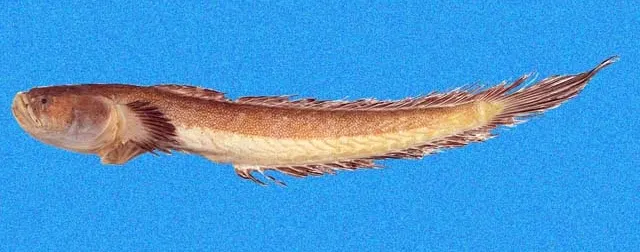
Akko rossi is an elongate goby with a large mouth opening at about 50 degrees to the horizontal, a tiny eye mostly filled by its lens, and a very small number of head pores, some occasionally missing. The jaws carry large teeth, in two rows on the lower jaw. The only specimen in the 2004 description was a female 90 mm long (standard length), and FishBase lists a maximum of 9 cm.
Live fish are reported as light pink, with darker red areas where blood capillaries show through the skin. What sets A. rossi apart from its two close relatives, Akko dionaea (from Brazil) and Akko brevis (from the eastern Pacific), is a set of counts and markings. It has about 115 scales along the side, against 53 to 60 in A. brevis and 76 in A. dionaea, and 17 tail vertebrae instead of 16. It also has dense dark pigment on the pectoral fins and the female genital papilla, which the other two lack. The describers noted that more specimens are needed to know whether the vertebra count is typical.
Where it lives
The species is recorded only from the coast of El Salvador, and the holotype came from the Gulf of Fonseca, in the eastern Pacific. The IUCN assessment counts four to five locations. It places the fish in shallow water of about 7 to 9.5 metres, in estuaries, over sandy and muddy seabed, and among submerged mangrove roots.
The fish was named for D. Ross Robertson, a marine biologist at the Smithsonian Tropical Research Institute in Panama. The genus name Akko comes from a Greek word for a bogeyman.
Pins are Wikidata “endemic to” fields. Orange dots, when present, are GBIF occurrence tiles — survey bias included.
How it lives
Very little is recorded. The holotype was trawled from mud, and FishBase says the species lives in burrows in black mud. Diet, breeding and lifespan have not been described.
Why it is in trouble
The 2025 assessment, made under criteria B1ab(iii)+2ab(iii), lists a decreasing population and a continuing decline in the area it occupies. The threats it names are run-off and the unintended effects of large-scale harvesting, which it rates as acting across more than 90 percent of the range. The holotype itself came up in a trawl. There is no population estimate.
The species was known from one fish for years. That reflects how little survey effort has been spent on it rather than proof of how rare it is, but it leaves any conclusion about its numbers uncertain.
What is being done
The assessment lists site and area management as a conservation action, and whether the species lives inside any protected area is marked as unknown. No species-specific recovery plan or monitoring programme is recorded.
Sources
Written for this catalog in our own words from the sources below, checked against them on 12 November 2026. Population figures are estimates and carry the year they were made. Status and assessment year: IUCN. 2026. The IUCN Red List of Threatened Species. Version 2026-1. iucnredlist.org.




