Endangered
Akiapolaau
Hemignathus wilsoni
The ʻakiapōlāʻau (ah-kee-ah-POH-lah-ow), also known as the Hawaiian woodpecker, is a Hawaiian honeycreeper that is endemic to the island of Hawaii.
Appearance
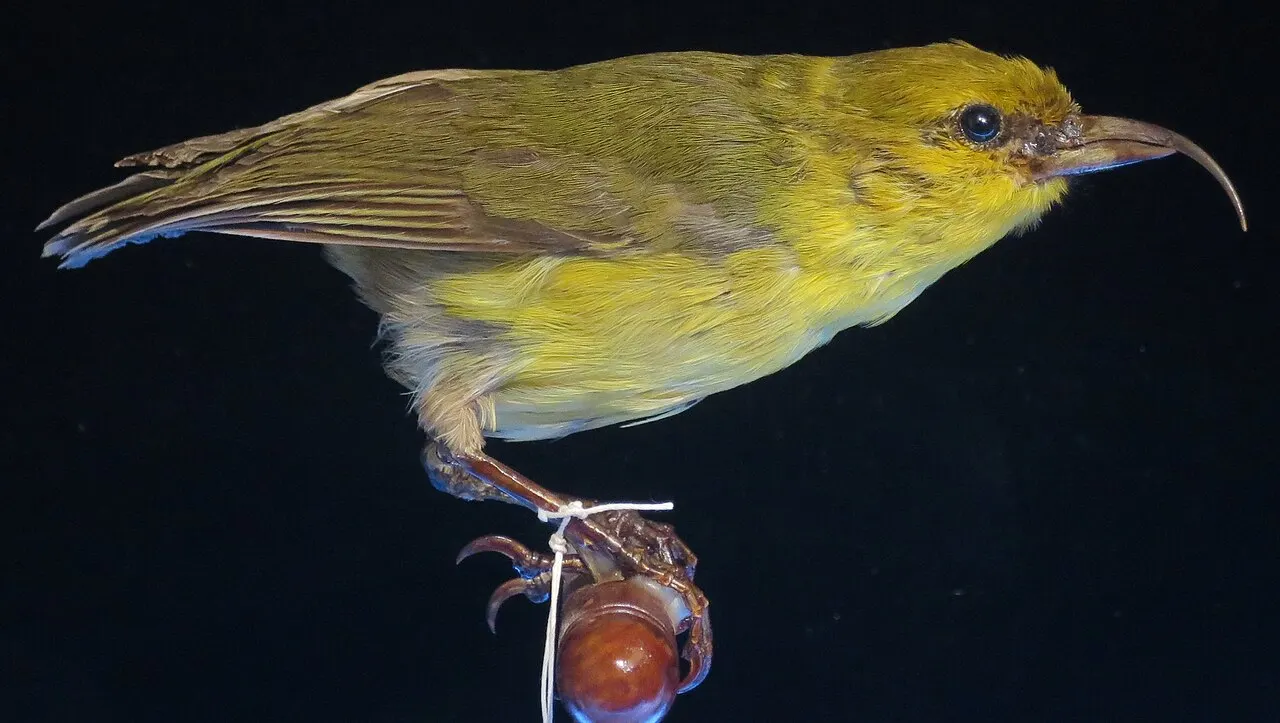
The bird is 5.5 inches (14 cm) in length, and has an unusually curved beak-(a specialist species). The ʻakiapolaʻau is a pudgy bird that has a whitish bottom and tail, black legs, yellow chest, orangish head, black face mask and bill and gray black wings.
Published measurements include mass about 1.5.
Range and habitat
The ʻakiapōlāʻau occurs mainly in old-growth mesic and wet forests in Kaʻū, Hilo District, and Hamakua. Koa (Acacia koa) and ʻōhiʻa lehua (Metrosideros polymorpha) are dominant canopy species in its habitat. It formerly inhabited māmane (Sophora chrysophylla) and naio (Myoporum sandwicense) dry forests at elevations of 1,900 to 2,900 metres (6,200 to 9,500 ft) on Mauna Kea, but this population was extirpated in 2002.
The ʻakiapōlāʻau (ah-kee-ah-POH-lah-ow), also known as the Hawaiian woodpecker, is a Hawaiian honeycreeper that is endemic to the island of Hawaii. Its natural habitats are dry and montane moist forests, and it is the only bird species on the island to occupy the woodpecker niche.
Pins are Wikidata “endemic to” fields. Orange dots, when present, are GBIF occurrence tiles — survey bias included.
Breeding
Several nests of this species have been discovered, most of them only having one egg, and the rate of the egg to maturation is only fifty percent. It breeds only every other year and is therefore a slow reproducer.
In crisis
Due to the recent disappearance of the Kauaʻi nukupuʻu in the 1900s and the Maui nukupuʻu in the 1990s, leading to fears that they may be extinct, the ʻakiapōlāʻau may be the last of its genus. Even so, after that the population was being affected by rats that ate its eggs, thus limiting the increase of the wild stock. The population broke down into four populations.
The smallest is three birds, another population has only twenty birds, and the largest of the small populations a group of forty-four. The largest population contains about 1,097 birds, and the figure appears to be dropping even though it is somewhat hard to find the birds.
Akiapolaau is Endangered on the IUCN Red List (assessed 2023, criteria B1ab(i,ii,iii,iv,v)). Confirm the official criteria and any later count on the assessment page.
Sources
Adapted from the English Wikipedia article on Akiapolaau (CC BY-SA 4.0; authors are listed in the article history; changes were made), Wikidata item Q27075770. Family and order context is original field-guide writing about the group, not a copied assessment of this one species. Not an IUCN assessment. Counts, when quoted, can change — confirm them on the recovery programme and on iucnredlist.org. Status and assessment year: IUCN. 2026. The IUCN Red List of Threatened Species. Version 2026-1. iucnredlist.org.




