Endangered
Ahaetulla perroteti
Ahaetulla perroteti
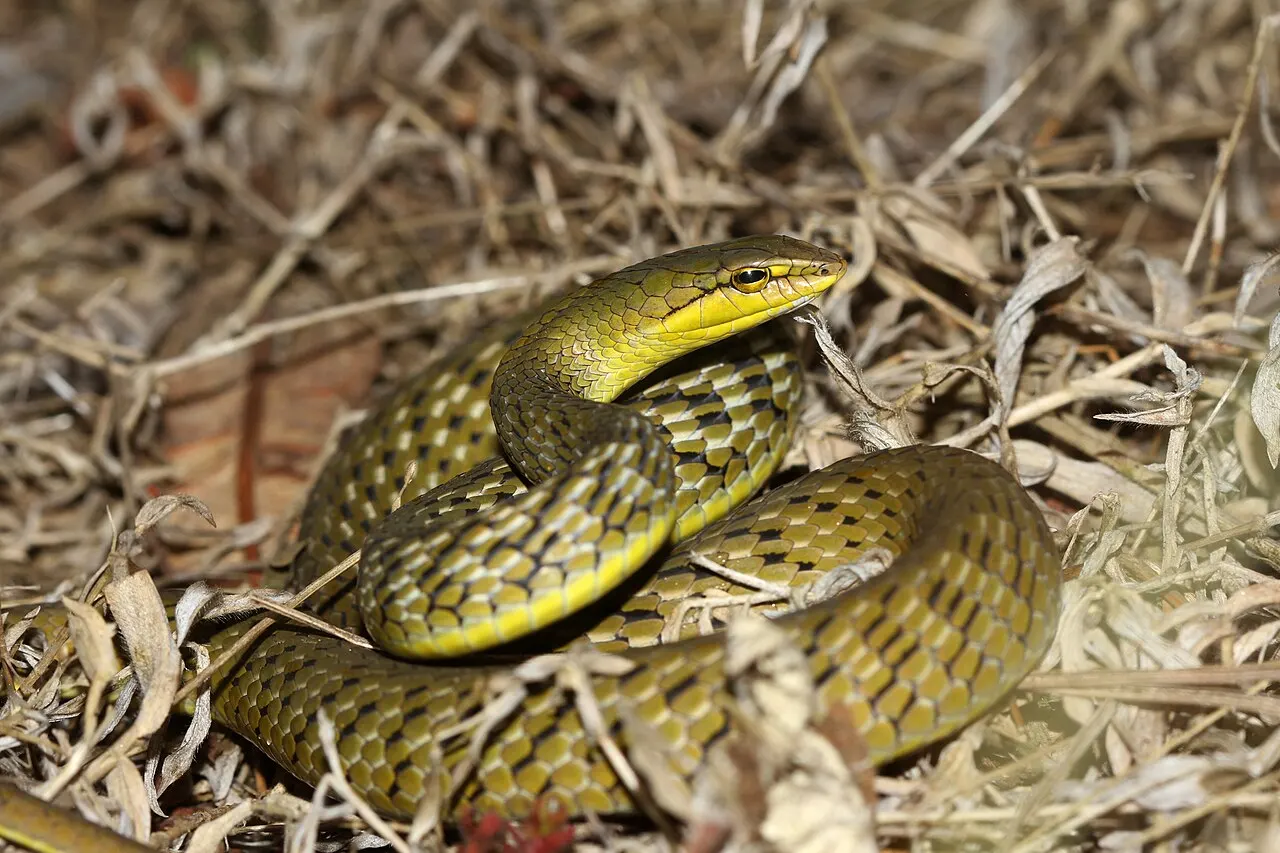
Perrotet's vine snake (Ahaetulla perroteti), also called the Western Ghats bronzeback, is a slender, mildly venomous snake found only on the high hills of the Nilgiris in Kerala and Tamil Nadu, India. The IUCN Red List assessed it as Endangered (published 2013) because its small range is split up and shrinking.
How to recognise it
It's a small vine snake, reaching about 61 cm (2 feet) in total length including a tail of roughly 14 cm. Males are bright green above with a pale green or yellowish belly and a green line along each side. Females are a duller brownish grey with a yellowish belly.
Unlike most Indian vine snakes it has no fleshy appendage on the tip of the snout. It also lacks the loreal scale between eye and nostril, and it has far fewer scales under the tail than the long-tailed A. dispar and A. travancorica (65 to 86 against 103 to 130). It's rear-fanged and mildly venomous.
Where it lives
The snake is endemic to the upper Nilgiris of the Western Ghats. Recorded sites include Mukurthi National Park, Silent Valley, Siruvani peak and Vellarimala (Camel's Hump). The IUCN counts one to five locations, places its habitat in high-altitude grassland, and gives an extent of occurrence of about 1,820 square kilometres.
Elevation figures differ between sources. The IUCN gives 2,000 to 2,800 m, the Reptile Database 1,980 to 2,300 m, and one encyclopedia account says above 1,600 m. Habitat is described as montane grassland, often mixed with patches of shola forest. Reports from Myanmar are considered probably wrong.
Pins are Wikidata “endemic to” fields. Orange dots, when present, are GBIF occurrence tiles — survey bias included.
How it lives
Despite the vine-snake name, it is mostly active on the ground, and has been seen basking in full sun in open grassland. Descriptions differ here too, with some calling it terrestrial to semi-arboreal and a 2018 classification treating it as fully arboreal.
Lizards and frogs make up most of its diet. A 2017 note from the Nilgiris reported it preying on the tiny bush frog Raorchestes tinniens, and a 2020 paper in Zoo's Print calls that frog a main food of this snake. Females give birth to live young, although the Reptile Database calls this ovoviviparous, meaning the eggs hatch inside the mother.
Why it is in trouble
The IUCN lists large-scale farming, plantations and small-holder farming as ongoing threats across most of its range, expected to cause slow but significant declines. The assessment describes the population as severely fragmented, with the area it occupies still shrinking. Its population trend is recorded as unknown, and no population size has been estimated.
What is being done
The IUCN records the species in at least one protected area, with 75 to 90 percent of the population estimated to fall inside protected land. It also records no recovery plan, no monitoring scheme and no captive population. Research on its numbers, distribution, life history and ecology is listed as needed.
Sources
Written for this catalog in our own words from the sources below, checked against them on 12 November 2026. Population figures are estimates and carry the year they were made. Status and assessment year: IUCN. 2026. The IUCN Red List of Threatened Species. Version 2026-1. iucnredlist.org.




