Endangered
Afropomus balanoidea
Afropomus balanoideus
Afropomus balanoideus is a small freshwater snail from the forest streams of West Africa. It is the only member of its genus, a lineage that appears to branch off early within the apple snails. The IUCN Red List assessed it as Endangered in 2020, with numbers decreasing.
How to recognise it
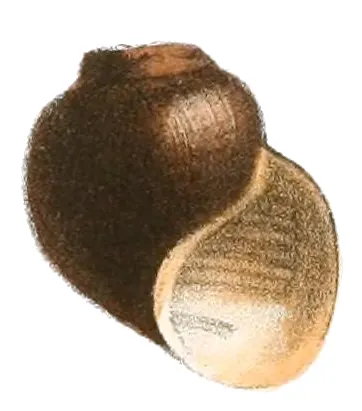
It is a modest apple snail. The shell is globular to ovate, about 20 mm across and 22 to 23 mm high, with a low spire and rounded whorls. A widened rim of the shell opening closes the umbilicus, the small hole at the base of many snail shells.
A form called nimbae, named in 1963 from the Mount Nimba area, has a more elongated shell with a higher spire. A later review, by Brown in 1980, did not recognise the distinction.
Where it lives
The Red List assessment records it in Sierra Leone, Liberia and Côte d'Ivoire. Gould described it in 1850 from Cape Mount in Liberia. Other references add Nigeria, and a presence in Ghana is uncertain. On Mount Nimba it has been recorded up to about 650 m.
It lives in small streams, creeks and ditches, and is said to need clean, well-oxygenated water. The assessment's habitat list gives permanent rivers and streams, and bogs, marshes and swamps.
Pins are Wikidata “endemic to” fields. Orange dots, when present, are GBIF occurrence tiles — survey bias included.
Where it fits
Anatomy, especially of the reproductive system, suggests Afropomus is a primitive genus in the apple snail family Ampullariidae, and molecular studies place it near the base of the family. Pilsbry and Bequaert named the genus in 1927, and it is the type genus of its own subfamily, Afropominae.
Why it is in trouble
The assessment names a run of pressures on the waters it needs. Herbicides and pesticides are rated as affecting most of the range and causing rapid declines. Small-holder and shifting agriculture, sewage and runoff also affect most of the range, causing slow but significant declines. Small-scale aquaculture affects a smaller share of the range. Dams, soil erosion and mining are listed as further ongoing threats.
The population trend is given as decreasing, with continuing decline in the area it occupies. The snail is recorded in at least one protected area. A snail that depends on well-oxygenated streams is exposed to pollution and silt, which is what most of these pressures bring.
Sources
Written for this catalog in our own words from the sources below, checked against them on 12 November 2026. Population figures are estimates and carry the year they were made. Status and assessment year: IUCN. 2026. The IUCN Red List of Threatened Species. Version 2026-1. iucnredlist.org.




