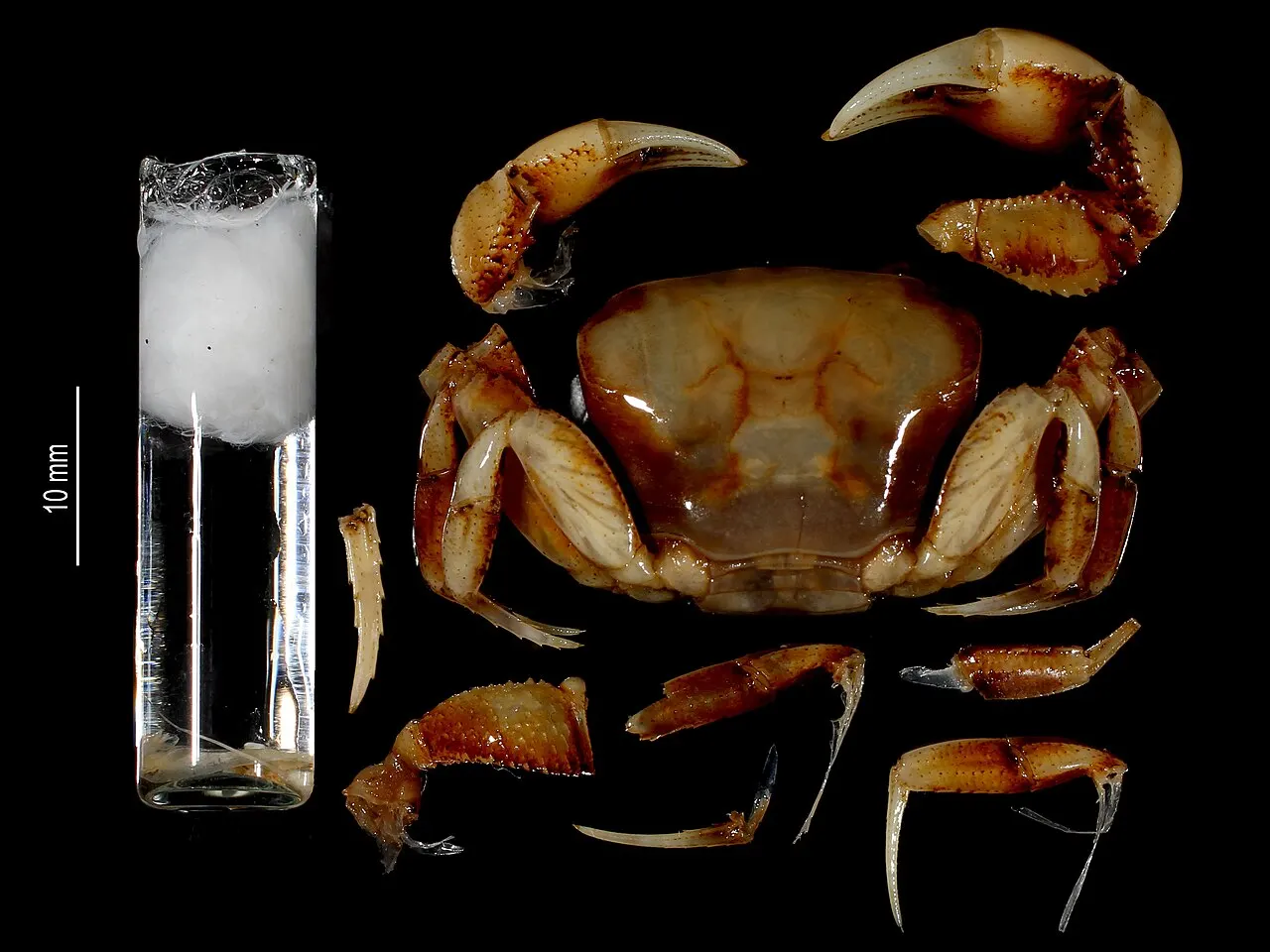
Endangered
Purple Marsh Crab
Afrithelphusa monodosa
The purple marsh crab (Afrithelphusa monodosa) is a freshwater crab known only from two places in northwest Guinea, with fewer than 20 specimens reportedly ever collected. The IUCN Red List lists it as Endangered (assessed 2020), with a decreasing population, mainly because farming is eating into its wet ground.
How to recognise it
The purple marsh crab is a medium-sized freshwater crab. Adults measure about 21.0 to 29.5 mm across the carapace (the main shell). The male that defined the species in 1959 was 21.5 mm wide, and a male collected at Sarabaya in 2005 was 24.3 mm.
In life the carapace is purple, the upper sides of the legs are orange, and the chest and undersides of the legs are cream. The carapace is oval and highly arched, the wrist of the claw is rough with granules, and the walking legs are long and slender.
Where it lives
The crab is known only from northwest Guinea, in Boke Prefecture, in the western part of the Upper Guinea rainforest block. The first specimen, a male, was collected at Boke on 1 April 1947 and described by Bott in 1959 under the name Globonautes monodosus. For decades that single crab was all anyone had.
Several more were collected in April 2005, 58 years later, at Sarabaya, north of Kamsar, at about 589 m above sea level. The Red List counts two locations in total. The other three species in the genus Afrithelphusa live in Guinea and Sierra Leone.
Pins are Wikidata “endemic to” fields. Orange dots, when present, are GBIF occurrence tiles — survey bias included.
How it lives
At Sarabaya the crabs were taken from burrows dug into cultivated land, in humid soil with a little water at the bottom. A 2023 revision of the genus describes the spot as marshy farmland.
The Red List lists its habitat as small freshwater marshes and pools (under 8 hectares) and bogs, marshes, swamps and fens, and records arable land as well. Little has been published about what it eats, how it breeds or how long it lives.
Why it is in trouble
The Red List names three kinds of farming as threats: agro-industry, small-holder farming and shifting agriculture. It records a continuing decline in the area of habitat. The species is listed under criterion B2ab(iii), which covers a small area of occupancy, few locations and declining habitat quality.
Because the crabs burrow in farmland, they live exactly where farming changes the land. The Red List records none of the known population inside a protected area.
What is being done
On-the-ground protection is thin. The Red List notes that conservation sites have been identified over part of the range, but no protected area holds the species. A genome resource bank (stored genetic material) is the only conservation action listed.
In 2023 a team led by Neil Cumberlidge revised the genus Afrithelphusa using new body-shape and DNA data in the Journal of Natural History. The revision calls for further population and distribution studies before conservation options can be considered.
Sources
Written for this catalog in our own words from the sources below, checked against them on 12 November 2026. Population figures are estimates and carry the year they were made. Status and assessment year: IUCN. 2026. The IUCN Red List of Threatened Species. Version 2026-1. iucnredlist.org.




