Endangered
Aetobatus ocellatus
Aetobatus ocellatus
The ocellated eagle ray (Aetobatus ocellatus), also called the whitespotted eagle ray, is a large, dark, white-speckled ray of shallow tropical seas across the Indo-West Pacific. The IUCN reassessed it in 2024 as Endangered, with a decreasing population, mainly because of fishing across much of its range.
How to recognise it
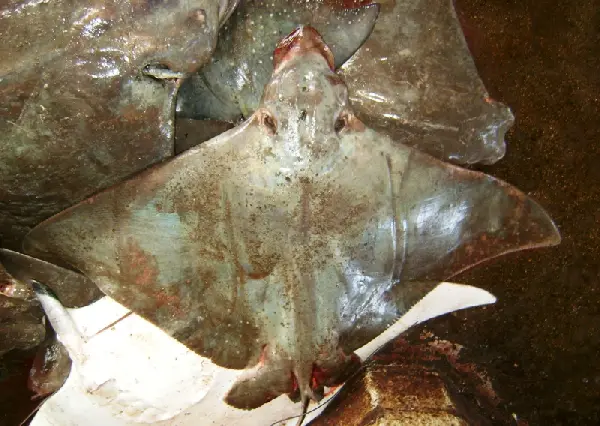
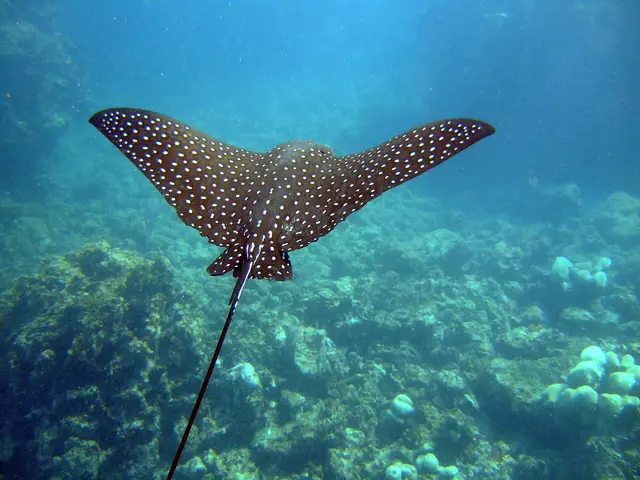
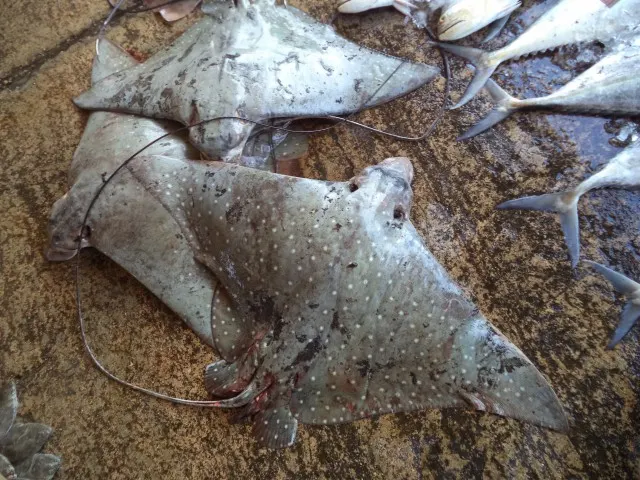
It is an eagle ray: a flat, winged body, a triangular snout and a very long, thin tail. The upper surface is dark slate grey to near black, often with white spots that can be sparse or almost absent, and the underside is white. Compared with the spotted eagle ray of the Atlantic, it has a longer tail, a longer stinging spine and a much darker back.
It was long treated as part of that Atlantic species (Aetobatus narinari) until a 2010 study by White and colleagues confirmed it as a separate, valid species. Some reports still call it the spotted eagle ray.
Where it lives
It ranges from the Red Sea and the east coast of Africa across the Indian Ocean to Japan, Southeast Asia, northern Australia and the central Pacific. Australian reports place it from the Sydney region round to Shark Bay in Western Australia. The IUCN lists dozens of countries and territories, from South Africa and Madagascar to Japan, the Philippines and Fiji.
It lives in inshore waters, lagoons, estuaries, sandy bottoms and coral reefs, and occasionally in the upper open sea. The IUCN gives its depth range as 0 to 40 m.
Pins are Wikidata “endemic to” fields. Orange dots, when present, are GBIF occurrence tiles — survey bias included.
How it lives
This ray eats snails, clams and other shellfish, along with crustaceans, worms, octopuses and some fishes. It is ovoviviparous: young develop inside the mother, first on yolk and then on nutrients from uterine fluid, and gestation lasts more than a year. Litters are small, reported as 2 to 10 pups and usually fewer than 4.
An Australian fisheries review puts maturity at 4 to 6 years, at about 100 to 130 cm across the disc for males and 150 to 160 cm for females. Maximum size is given as about 300 cm disc width. Some life-history figures there come from studies of related eagle rays, so treat them as approximate. The IUCN uses a generation length of 13 years, and a slow-breeding ray like this is likely to recover slowly from heavy fishing.
Why it is in trouble
The 2024 assessment, under criterion A2bcd, records a decreasing population. The main recorded threat is fishing: the ray is caught on purpose and by accident in small-scale and large-scale fisheries, scored as medium impact, and persecution is a smaller factor. Coastal development, pollution and run-off, and temperature extremes are also listed, with effects not yet measured.
The IUCN lists use as human food, animal feed, aquarium animals and items such as clothing and accessories. A 2023 Australian review inferred sharp population falls across Southeast Asia and the Indian Ocean, where fishing is mostly unregulated, while Australian catches are low and populations there are thought to be stable.
What is being done
The IUCN reports that the species occurs in at least one protected area and that some international trade controls apply. It lists harvest management, trade management, species recovery and site protection as actions, but records no monitoring scheme, recovery plan or harvest management plan in place. In northern Australia, bycatch reduction devices required in some trawl fisheries have been shown to cut catches of this ray by more than 90 percent.
Sources
Written for this catalog in our own words from the sources below, checked against them on 12 November 2026. Population figures are estimates and carry the year they were made. Status and assessment year: IUCN. 2026. The IUCN Red List of Threatened Species. Version 2026-1. iucnredlist.org.