Critically Endangered
Adetomyrma venatrix
Adetomyrma venatrix
Adetomyrma venatrix, one of the so-called Dracula ants, is a tiny, pale, blind ant that lives in the forests of Madagascar and nowhere else. It was described in 1994 and listed as Critically Endangered by the IUCN in 1996. Its nickname comes from adults reportedly feeding on the blood of their own larvae.
How to recognise it
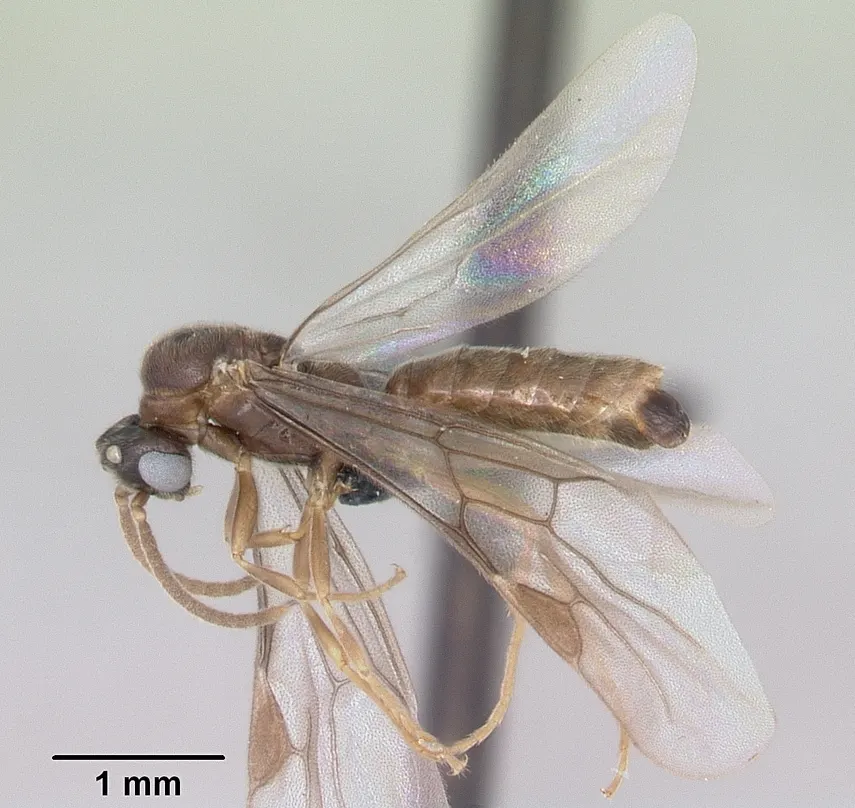
This is an ant you would struggle to notice. Workers are only about 2 mm long, light yellow-brown with narrow darker bands on the rear edge of some abdominal segments, and covered in a dense layer of pale upright hairs. They are blind. The head is longer than wide, and a row of about 20 small, conical bristles sits along the front edge of the face.
The sting is long. Philip Ward, who described the species, was stung on the finger and recorded a noticeable sting followed by slight swelling that lasted several days.
Where it lives
The first workers were collected on 15 February 1993 in Zombitse Forest in western Madagascar, along the main road about 15 km east of Sakaraha, at 760 m above sea level. They were under a rotten log, at the point where it met the soil. The habitat was tropical dry forest.
Pins are Wikidata “endemic to” fields. Orange dots, when present, are GBIF occurrence tiles — survey bias included.
How it lives
Very little has been observed. Ward found the workers moving as a group and thought they might recruit nestmates to prey, though he did not see it. He suspected a specialised predator of ground-dwelling arthropods that lives underground and is seldom seen.
The feeding habit behind the nickname is the best known part. A 2026 article in BBC Wildlife describes adults scratching, scraping or chewing at their larvae and drinking the fluid that leaks out, a behaviour called non-destructive cannibalism. The larvae survive and grow into scarred adults. One idea is that larvae act as a communal stomach for the colony. These details are drawn from popular coverage of the species rather than from detailed field study.
Why it is in trouble
The IUCN assessment dates from 1996 and gives only the Critically Endangered category, the criteria and Madagascar as the range. It lists no population figure or threat details. Ward noted that slash-and-burn farming had destroyed large areas of forest along the same road, leaving degraded savanna woodland after a few crop cycles, and the collection site lay within 100 m of the road. How many colonies survive is unknown.
Sources
Written for this catalog in our own words from the sources below, checked against them on 12 November 2026. Population figures are estimates and carry the year they were made. Status and assessment year: IUCN. 2026. The IUCN Red List of Threatened Species. Version 2026-1. iucnredlist.org.




