Endangered
Kandyan dwarf toad
Kandyan dwarf toad
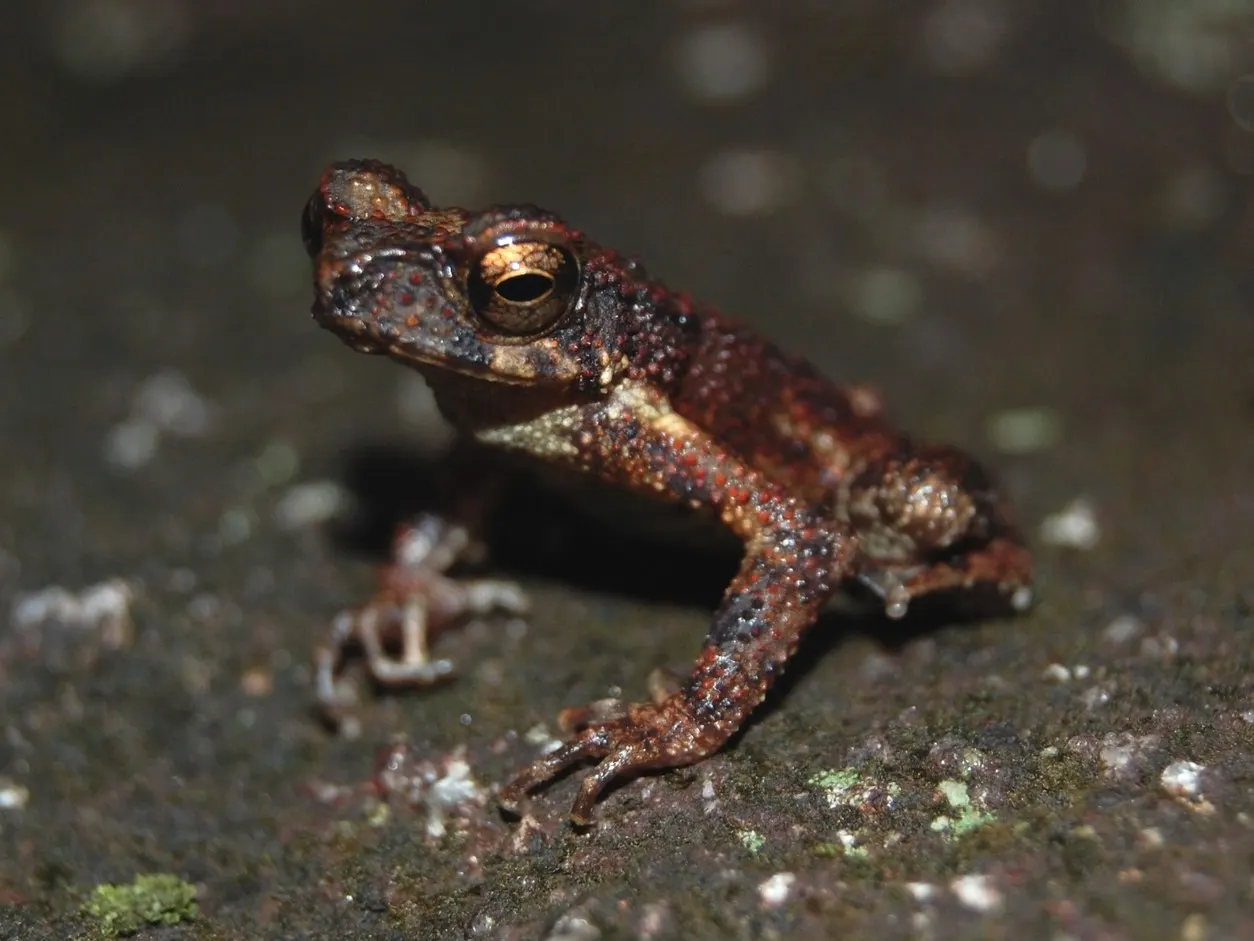
The Kandyan dwarf toad is a small, golden-bellied toad found only in the hill forests of Sri Lanka. Described in 1872 and then unrecorded for well over a century, it was rediscovered in 2009. The IUCN Red List rated it Endangered in 2020, with a decreasing population.
How to recognise it
It is a small toad. Adult males measure about 30 to 35 mm from snout to vent, and females are larger at about 40 to 45 mm. The back is yellowish brown, the head reddish, and a thin gold stripe can run down the spine. The glands behind the eyes (parotoid glands) are dark brown and fairly long, and the belly is gold.
The eardrum is submerged and hard to see, the toes are partly to fully webbed and the fingers are not. The long parotoid glands help separate it from the related Adenomus kelaartii. The tadpoles are flattened, with a large sucker disc on the underside that covers more than half the body.
Where it lives
The species is endemic to Sri Lanka and lives in montane cloud forest and moist tropical forest, in and beside hill streams. Recorded elevations run from about 1,000 to 1,879 m. The IUCN counts four locations and estimates the extent of occurrence at roughly 1,000 square kilometres.
The 2009 rediscovery came in the Peak Wilderness Sanctuary, on the trail to Adam's Peak. A second living population was reported from the Pidurutalagala Forest Reserve in 2014. The name kandianus points to the city of Kandy, but the IUCN notes that in the late 19th century the whole Central Province was called Kandy, so the original locality is vague.
Pins are Wikidata “endemic to” fields. Orange dots, when present, are GBIF occurrence tiles — survey bias included.
How it lives
Very little has been written about its daily life. Researchers found it at night on rocks beside fast-flowing streams, and its tadpoles develop in the streams. The IUCN describes it as not migratory.
A species given up for lost
Albert Günther described it in 1872, and the last known record came in 1876. It was listed as Extinct in 2004. On 23 October 2009, a survey team led by herpetologist Mendis Wickramasinghe found about four toads in one night in the Peak Wilderness Sanctuary and collected one. The team first took the specimen for a close relative, Adenomus dasi, until it was examined closely. The rediscovery was announced in 2012, and the toad was reportedly rated Critically Endangered before the 2020 assessment placed it at Endangered.
The partly webbed toads once treated as a separate species, A. dasi, show negligible genetic difference from it, so the IUCN now treats that name as part of A. kandianus.
Why it is in trouble
The IUCN lists a long set of pressures, including habitat shifting and alteration, small-holder farming, roads, small dams, droughts, run-off, acid rain, garbage and light pollution. Recreational activities also appear, and waste from pilgrims climbing Adam's Peak has been reported to pollute the sanctuary's streams. Wet-zone forest loss across Sri Lanka is named as a wider threat to its amphibians.
The 2020 assessment records a continuing decline in habitat area and a decreasing population trend. No total population estimate exists.
What is being done
The toad occurs in at least one protected area. The IUCN lists site and area protection, site management and habitat protection as the conservation actions needed. Research on its population size, distribution and trends, its life history and its threats is also listed.
Sources
Written for this catalog in our own words from the sources below, checked against them on 12 November 2026. Population figures are estimates and carry the year they were made. Status and assessment year: IUCN. 2026. The IUCN Red List of Threatened Species. Version 2026-1. iucnredlist.org.




