Endangered
Acroteriobatus leucospilus
Acroteriobatus leucospilus
The grayspotted guitarfish, Acroteriobatus leucospilus, is a shark-like ray of shallow sandy seabeds along the south-east coast of Africa. The IUCN Red List rated it Endangered in 2019, after two earlier Data Deficient listings, because fishing is thought to have cut its numbers by about half in 15 years.
How to recognise it
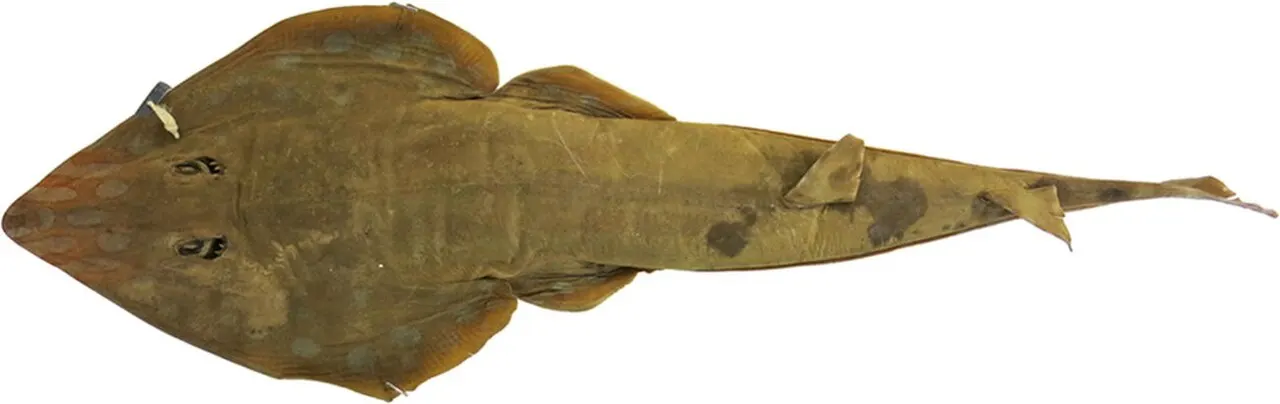
Guitarfishes are rays with a shark-like build. This one is sandy brown above, with small and large bluish spots ringed in a darker tone, plus brownish spots over the disc, tail and fins. The snout is semi-translucent with elongated bluish spots, giving a stripe-nosed look. The underside is white.
The skin is mostly smooth and velvety, with a few coarse denticles around the eyes and a row of enlarged ones down the midline of the back. The largest verified specimen was a 96 cm female. Older sources give 1.2 m, but no specimen that size is known, and those reports may have involved a larger look-alike species.
Where it lives
Norman described it in 1926. It has been recorded from off the central Transkei coast of South Africa, north through KwaZulu-Natal to Mozambique, and, according to a 2021 revision, as far as Zanzibar and Dar es Salaam in Tanzania.
That 2021 revision, by Weigmann, Ebert and Séret, also described a separate, larger species, Acroteriobatus andysabini, known from the coast of Madagascar. The Red List assessment from 2019 predates the revision and lists Madagascar alongside South Africa, Mozambique and Tanzania, so its figures may include fish that are now treated as another species. Madagascar may no longer belong in the grayspotted guitarfish's range.
It lives on subtidal sand, mud and sandy mud from the surf zone to 100 m. FishBase gives typical depths of up to about 37 m.
Pins are Wikidata “endemic to” fields. Orange dots, when present, are GBIF occurrence tiles — survey bias included.
How it lives
Like other guitarfishes it is ovoviviparous: the young develop in eggs that hatch inside the mother, and litters are small, usually two to four pups. In the 2021 examination of 11 specimens, those longer than about 565 mm were mature, and pregnant females ranged from 564 to 921 mm. FishBase lists the diet as bivalves, gastropods, shrimps, crabs and small bony fishes.
Slow reproduction makes it a species that recovers slowly. The Red List uses a generation length of five years, and FishBase rates its resilience as very low, with a population doubling time of more than 14 years.
Why it is in trouble
The cause is fishing. The 2019 Red List assessment estimates a reduction of 50% over the past three generations (15 years), based on actual or potential levels of exploitation. Harvest for human food, at subsistence and large scale, and unintentional catch are all scored as ongoing threats, and international trade is flagged. The assessment scores the intentional small-scale harvest as the heaviest.
The species was rated Data Deficient in both 2009 and 2016, so the 2019 listing reflects better information as well as fishing pressure.
What is being done
Little is in place. At the time of the assessment there was no recovery plan, no monitoring scheme, no harvest management plan and no captive breeding, and it was not known whether it occurs in any protected area. The Red List calls for species recovery plus management of harvest and trade.
Sources
Written for this catalog in our own words from the sources below, checked against them on 12 November 2026. Population figures are estimates and carry the year they were made. Status and assessment year: IUCN. 2026. The IUCN Red List of Threatened Species. Version 2026-1. iucnredlist.org.




