Red list
Desert rain frog uplisted to Vulnerable
Updated 2 October 2026
On 9 July 2026, the International Union for Conservation of Nature issued a press release from Gland, Switzerland, announcing an update to the IUCN Red List of Threatened Species. Within that update, the desert rain frog (Breviceps macrops), a rotund burrowing amphibian that lives in a narrow strip of coastal sand in northwestern South Africa and southwestern Namibia, was reclassified from Near Threatened to Vulnerable, joining 49,505 of the 175,909 species now assessed as threatened with extinction on the List. The change is the first formal reassessment of the species since 2011, and the underlying drivers, which include opencast diamond mining, the proposed Boegoebaai port and green hydrogen project, urban expansion, and a documented rise in pet trade interest, are continuing to act on the frog's restricted range.
What changed for the desert rain frog on 9 July 2026?
On 9 July 2026, the International Union for Conservation of Nature published its latest update to the IUCN Red List of Threatened Species, accompanied by a press release issued from the Union's headquarters in Gland, Switzerland. Within that update, the desert rain frog (Breviceps macrops) was reclassified from Near Threatened to Vulnerable, a one-step shift up the threat scale that reflects an ongoing and documented deterioration of the species' habitat across its restricted range.
The shift places the desert rain frog on a Red List that, as of the same update, includes 175,909 species, of which 49,505 are now classified as threatened with extinction. Other species whose status moved in the same release include the numbat (Myrmecobius fasciatus), the faunal emblem of Western Australia, which improved from Endangered to Near Threatened thanks to feral predator control and reintroduction work, and a set of five Australian marsupials newly recognised through taxonomic review and confirmed as Extinct: the little bettong, and the crested-tailed, southern, northern, and little mulgaras.
The desert rain frog change was the only amphibian reassessment singled out in the press release's headline paragraph. The release explicitly identifies diamond mining and proposed industrial development, including a green hydrogen project, as the drivers of the uplisting, alongside a rise in suspected pet trade interest following viral recordings of its distress call on social media.
Why has the desert rain frog moved closer to extinction?
The IUCN assessment identifies four pressures acting on the species in its narrow range, and the assessment's projected decline of approximately 20 per cent over the next decade is the cumulative result of those pressures rather than the effect of any single one. The first is opencast diamond mining, which has already removed large areas of suitable sand dune habitat in the South African portion of the frog's range. The second is the proposed Boegoebaai port and green hydrogen project, which the IUCN projects could directly impact up to one-third of the frog's South African range and two-thirds of its Namibian range over the next 20 years. The third is urban expansion along the Northern Cape coast of South Africa, where small-town growth and associated infrastructure continue to chip away at dune habitat. The fourth is a suspected rise in pet trade interest, driven by viral social media videos of the frog's high-pitched distress call.
The IUCN statement on the assessment notes that climate change and associated heat stress and aridification are possible further strains on this species, although the published threshold for the Vulnerable reclassification is the 20 per cent projected population reduction over the next decade rather than the longer-term climate trajectory. Dr Jeanne Tarrant, executive director of Anura Africa and regional co-chair of the IUCN Amphibian Specialist Group for Southern Africa, told Mongabay that the species has already experienced loss of its habitat from strip mining and that the projected impacts do not bode well for the species and the other unique biodiversity that occurs only in these coastal dune systems.
Where exactly does the desert rain frog live, and what is its range?
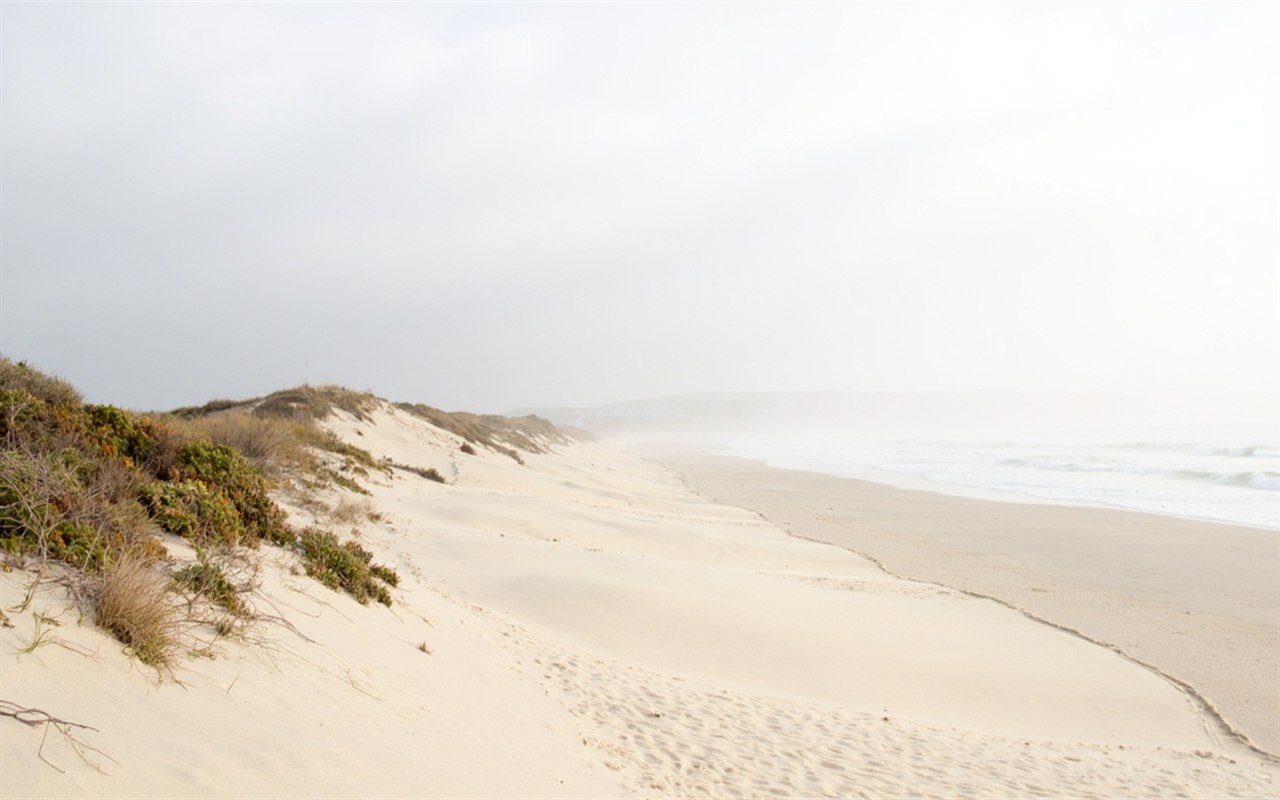
The desert rain frog is found only in a narrow strip of white coastal sand dunes in northwestern South Africa and southwestern Namibia. Mongabay, reporting on the IUCN assessment, places the species within 10 to 12 kilometres of the Atlantic coast. The Guardian, reporting on the same assessment a day later, places the species in a narrow strip of the north-west coast of South Africa and in south-western Namibia, and emphasises that it can be found nowhere else on the planet.
Within that coastal strip, scientists have identified six distinct habitat locations of the frog, all within the Succulent Karoo biome. The biome is a recognised biodiversity hotspot, listed on UNESCO's Tentative List of World Heritage Sites, and hosts a high concentration of endemic plant species adapted to winter-rainfall desert conditions. The frog's six recognised locations are not contiguous: they are fragmented patches of suitable dune, separated by stretches of rocky or vegetation-poor shore that the frog does not occupy.
What does the desert rain frog look like, and how big is it?
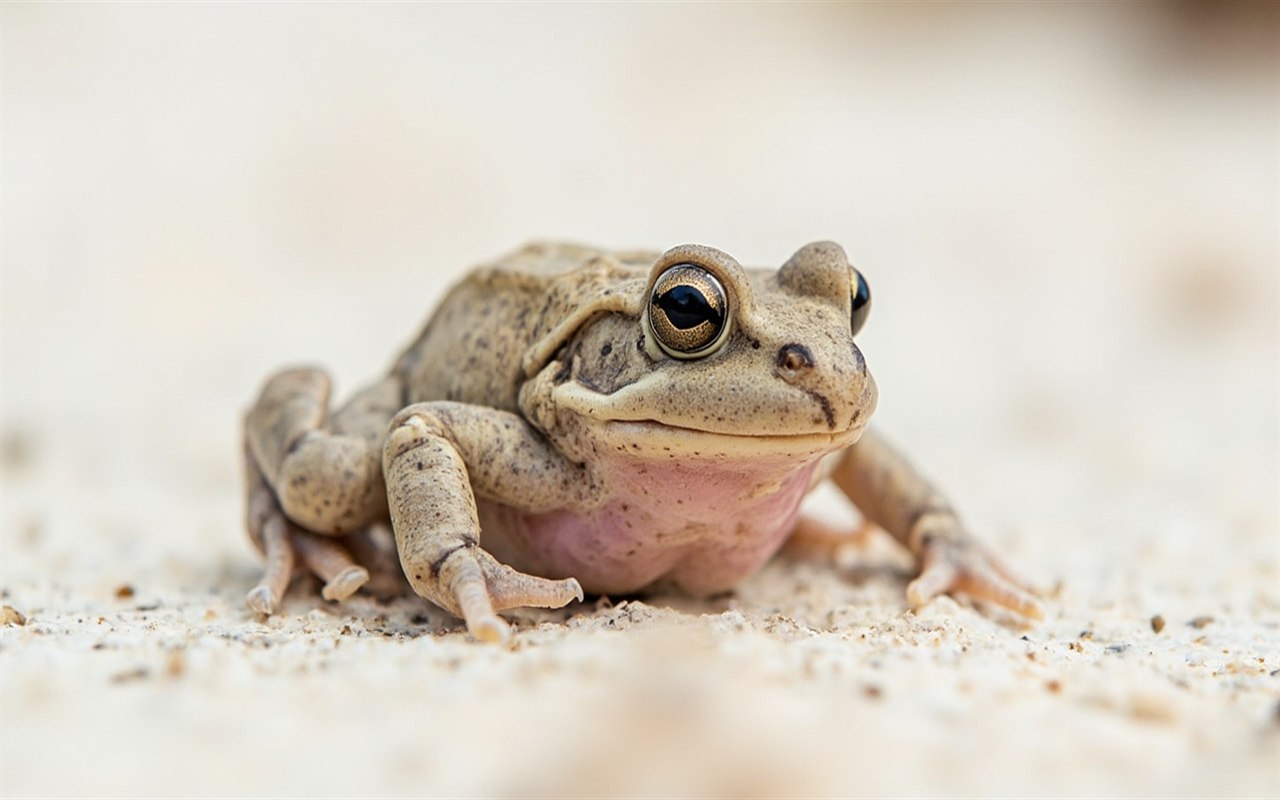
The desert rain frog is small, rotund, and visually distinct from the typical frog. Mongabay reports the species' length as 4 to 6 centimetres. The Guardian's profile describes it as having a rotund body and stumpy legs that dig rather than jump, evolved to survive not in wetlands or rainforests but in the unforgiving dunes of the southern African desert.
The species' colour is a pale grey to sandy brown, blending closely with the coastal sand it lives on. Its eyes are proportionally large and dark. Its limbs are short, with hind feet that are shaped less for jumping than for digging, and which Dr Jeanne Tarrant describes in the Guardian as their little shovels, with which they will burrow down and disappear within seconds. The body shape, which Professor Louis du Preez of North-West University in South Africa describes as a little fat froggy, is an evolutionary trade-off: a long, thin body like a snake would mean a bigger surface area, which would increase the risk of moisture loss through evaporation. The rounded, compact form holds moisture more efficiently in an environment where every drop has to be wrung from the air.
How does an animal that never drinks water survive in a sand dune?
The desert rain frog never drinks standing water. It survives without a permanent source of freshwater by absorbing moisture from coastal fog, and it spends most of its life buried beneath moist sand, emerging when conditions are just right. The frog's daily cycle is timed to the moisture cycle of the dune: it emerges at night, hunts briefly, and retreats below the surface before the surface sand dries out under the morning sun.
The retreat below the surface is the key adaptation. The sand on the surface of the dunes is bone dry, so the frog tunnels down backwards, descending about 30 centimetres, until it finds a damp layer where it can rest. The amount of time spent below the surface varies, but the frogs can remain there for months, living off the small amount of oxygen present in the soil, according to Professor Louis du Preez, who leads the African Amphibian Conservation Research Group at North-West University.
When the frog resurfaces, usually at night and during or shortly after a fog event, it searches for patches of water formed by condensed fog that has dripped from plants on to the sand. It sits on these patches, absorbing moisture through the highly vascularised pink patch on its belly. A favourite snack during these surface visits is fat-rich termites, and Du Preez notes that the frog finds termites irresistible: if it is absolutely at full capacity and there is another termite walking past, it will go for it, and you just see the termite wings sticking out of the mouth, since they cannot swallow another one but will take it regardless.
How does the desert rain frog breed, and what is unusual about its reproduction?
The desert rain frog's reproduction is one of the unusual features of its biology, and one of the reasons that its restricted range matters so much to its survival. The mechanics of pairing are driven by the female's body shape: she is too rotund to hang on to the male, so the male frog attaches himself to the female by secreting a glue on his chest and forearms, gluing himself in place for the duration of mating.
After mating, the female digs into the soil and creates a chamber to deposit the eggs, which the male fertilises. On top of the fertilised eggs, the female lays unfertilised eggs, which later liquefy. When the tadpoles hatch in the subterranean chamber, they whip this liquid into a foam that traps oxygen. The result is a self-contained breeding system in which the developing tadpoles do not need free water to breathe, only the foam chamber and the moisture of the dune.
Professor Louis du Preez told the Guardian that, among all the frogs in the world, this one has got really unique breeding, biology, physical features, morphology, and that conserving sand dunes is the best way to protect the species. The entire process, from pair-bonding through foam-nursery, depends on the integrity of the dune structure and the moisture regime of the sand. Mining that removes and replaces sand, infrastructure that fragments dune continuity, and climate change that shifts the fog and rainfall pattern directly threaten the frog's entire breeding cycle.
Why is opencast diamond mining the most established threat to its habitat?
Opencast diamond mining is the most established threat to the desert rain frog's habitat because it physically removes the sand dunes and the vegetation that the frog depends on, and because the recovery of those dunes is incomplete. Mongabay's reporting cites research suggesting that, although mining companies replace the sand after extraction, the vegetation does not naturally recover well enough for the frogs to recolonise the areas.
The diamond mining takes the form of strip mining along the coastal dunes of the Northern Cape, in the South African portion of the frog's range. The mining method extracts minerals from an open pit in the ground, removing both the sand and the dune vegetation on top of it. Once mining is complete, the operator replaces the sand and the area is reclaimed, but the vegetation community that supported the frog's moisture and prey base does not return at the same density or composition. Without the vegetation, the fog does not condense on the dune in the same way, and the frog's moisture economy collapses.
What is the Boegoebaai green hydrogen and port project, and how much habitat would it touch?
The Boegoebaai proposal is a port, rail, and green hydrogen development planned for the Northern Cape coast of South Africa, and is named in both the IUCN press release and Mongabay's reporting as a key driver of the desert rain frog's reassessment. The proposal combines a deepwater port at Boegoebaai, rail infrastructure linking the port to inland mineral and energy corridors, and a green hydrogen production and export facility powered by renewable electricity.
The IUCN projects that expanding industrial developments, which include the green hydrogen project, are expected to impact up to one-third of the desert rain frog's range in South Africa and two-thirds of its range in Namibia within the next 20 years. Jeanne Tarrant told Mongabay that the proposed green hydrogen development and its associated infrastructure are most worrying, as these will directly impact the desert rain frog's habitat, because the species spends most of its life burrowed underground. The Guardian's reporting places the project within a broader pattern of port, rail, and energy infrastructure expansion in the Northern Cape.
How has social media attention turned a distress call into a pet trade risk?
The desert rain frog is one of the most distinctive amphibian sounds on the internet, and that distinction is now a conservation liability. The frog produces a high-pitched squeak that sounds, to the human ear, like a squeaky dog toy. The sound is in fact a distress call, usually made in response to predators. Jeanne Tarrant told the Guardian that the videos are usually recorded with the frog under stress, and that someone would have been poking it with a stick or traumatising it a bit to get it to make that call.
The recordings have been shared widely on social media and have racked up millions of views. Tarrant reported a surge in online searches inquiring how to obtain a desert rain frog. It is not yet clear if this is translating into the frogs being snatched from the wild, and Tarrant is clear that the link between viral videos and wild collection is suspected rather than measured, but the direction of pressure is consistent with patterns documented in other popular amphibian species.
The IUCN's updated assessment cites suspected demand for the desert rain frog in the pet trade following the viral video of the species calling in distress. Conservationists warn that the desert rain frog must be kept in its habitat, and that it would be very difficult for pet owners to recreate the conditions necessary for it to thrive. The combination of a charismatic appearance, an unusual sound, and an impossibly specific care requirement is the case that the pet trade is unlikely to satisfy without damage to the wild population.
How many distinct populations of desert rain frog are recognised, and where do they sit?
Scientists have identified six distinct habitat locations of the desert rain frog within the Succulent Karoo biome, all threatened with mining, energy, and infrastructure development. The locations are not described in the IUCN press release with specific coordinates, but the reporting in Mongabay and the Guardian identifies them as fragments within the coastal strip running from southwestern Namibia through the Northern Cape of South Africa.
The six locations are not contiguous. They are patches of suitable dune separated by stretches of rocky or vegetation-poor shore that the frog does not occupy. The fragmentation matters because the frog does not move easily across unsuitable terrain. The species is a burrower, not a disperser, and its daily movements are measured in metres rather than kilometres. The result is that each of the six populations is, in practice, a small or large closed breeding unit isolated from its neighbours.
What does the IUCN Red List assessment actually measure, and what is the projected decline?
An IUCN Red List assessment measures the risk of extinction that a species faces, using a set of quantitative criteria set out in the IUCN Red List Categories and Criteria. For amphibians, the most commonly applied criteria are A, which measures rate of population decline over 10 years or three generations, and B, which measures geographic range as extent of occurrence or area of occupancy, combined with measures of fragmentation, decline, or fluctuation.
The desert rain frog's reassessment to Vulnerable implies that the species meets at least one of the criteria thresholds for Vulnerable under the system. The IUCN's projected 20 per cent population decline over the next decade, which is the figure cited in the IUCN press release, places the species at the threshold of criterion A4, which is the category used for the rate of population reduction over a 10-year period including the past and the future. A reduction of 20 per cent is the lower bound of the Vulnerable category under criterion A4, with Endangered beginning at 50 per cent.
Who carried out the assessment, and what conservation steps are already in motion?
The reassessment was carried out by scientists from various Southern African universities and organisations, with Dr Jeanne Tarrant, executive director of Anura Africa and regional co-chair of the IUCN Amphibian Specialist Group for Southern Africa, acting as a lead spokesperson. The biology of the species, including the burrowing behaviour and the unique breeding system, was set out in the Guardian's profile by Professor Louis du Preez of North-West University in South Africa, who leads the African Amphibian Conservation Research Group.
There are currently no coordinated conservation efforts in place for the species, according to Mongabay's reporting. Tarrant told Mongabay that there really needs to be a consolidated effort now, based on this change in status to more threatened, to drive conservation and research action for this species. Researchers have, however, initiated a Green Status assessment of the frog for the IUCN, which evaluates a species' recovery potential and identifies priority research and conservation actions.
Why did the IUCN decide Vulnerable rather than Endangered for this frog?
The IUCN's Vulnerable category sits below Endangered and Critically Endangered on the threat scale, and the threshold between them is set by quantitative criteria. Under criterion A4, which measures population reduction over a 10-year period including the past and the future, Vulnerable begins at a 20 per cent reduction and Endangered begins at a 50 per cent reduction. The desert rain frog's projected 20 per cent reduction places it at the lower bound of the Vulnerable category.
Under criterion B, which measures geographic range as extent of occurrence or area of occupancy, Vulnerable can be triggered by a restricted range combined with continuing decline. The desert rain frog's range is restricted to a narrow coastal strip, but the assessment did not classify the species as severely fragmented, nor did it limit the number of locations to five or fewer in a way that would push the species into Endangered under criterion B. The assessment concluded that the species qualifies for Vulnerable rather than Endangered based on the combination of its restricted range and its projected rate of decline.
What does the Succulent Karoo biome have to do with the survival of a single species?
The Succulent Karoo biome is one of 36 recognised biodiversity hotspots, an ecoregion with high endemism and high threat. The biome runs along the Atlantic coast of southwestern Africa and is dominated by winter-rainfall desert vegetation, including a high density of leaf-succulent plant species that exist nowhere else on Earth. The desert rain frog is one of the biome's endemic animal species, and the threats to the frog's habitat are the threats to the biome as a whole.
The biome is on UNESCO's Tentative List of World Heritage Sites, with the listing entry noting its exceptional plant diversity and its vulnerability to mining, energy, and agricultural development. The threat has not been theoretical: opencast diamond mining has removed large areas of dune habitat in the South African portion of the biome, and the proposed Boegoebaai project is a structural pressure on the Namibian portion. The cumulative footprint of these pressures is now sufficient to push an endemic amphibian species across the threshold from Near Threatened to Vulnerable.
Quick answers
- What happened to the desert rain frog on the IUCN Red List in 2026?
- On 9 July 2026, the IUCN Red List update reclassified the desert rain frog (Breviceps macrops) from Near Threatened to Vulnerable. The change reflects a projected population decline of around 20 per cent over the next decade, driven by opencast diamond mining, the proposed Boegoebaai port and green hydrogen project, urbanisation, and a possible rise in pet trade interest.
- Why is the desert rain frog threatened?
- Three pressures are combining. Opencast diamond mining has already removed sand dune habitat in the South African portion of the frog range. The proposed Boegoebaai port and green hydrogen project is projected to affect up to one-third of the frog range in South Africa and two-thirds in Namibia over the next 20 years. Viral social media videos of the frog distress call have driven a surge in online searches about how to obtain one.
- How big is the desert rain frog?
- The desert rain frog is 4 to 6 centimetres long, with a rotund body, short legs, and a pink, highly vascularised belly patch that absorbs moisture from coastal fog. It is one of the smaller members of the Breviceps genus.
- Where does the desert rain frog live?
- The frog lives only in a narrow coastal strip of white sand dunes in northwestern South Africa and southwestern Namibia, within 10 to 12 kilometres of the Atlantic coast, in the Succulent Karoo biome. Six distinct habitat locations have been identified within that strip.
- What is the projected population decline without conservation action?
- The IUCN projects a population decline of approximately 20 per cent over the next decade if conservation measures are not introduced. The IUCN Red List as of July 2026 includes 175,909 species, of which 49,505 are threatened with extinction.
Field reporting on species in decline. Sourced, not sponsored.