Dipneusti in crisis
1 records. Red List version 2026-1
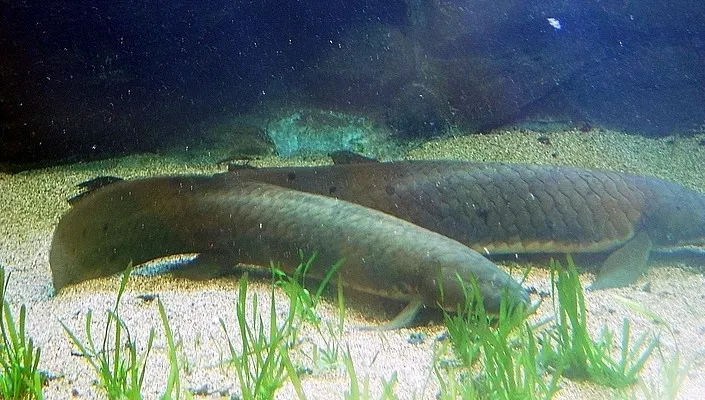
In this catalog, Dipneusti stands for lungfishes. We list 1 lungfishes that the IUCN Red List records as threatened enough to be Critically Endangered, Endangered or Extinct in the Wild: 1 Endangered.
This is the only member of the group in the catalog, so the whole shelf is one record.
A class is a filing shelf, not a measure of risk: it says nothing about how fast any one species is declining. Status and assessment years come from the IUCN Red List (version 2026-1); how to read an IUCN assessment explains what the categories and criteria mean, and each record links to its own assessment.
Lungfishes are freshwater fishes that can breathe air through lungs. Six species survive: four in Africa, one in South America and one in Australia. They were once widespread across the globe, and their fossil record reaches back more than 410 million years, to the Early Devonian.
Their lungs open into the throat without a windpipe and are divided into many small air sacs. Most living species have two lungs; the Australian species has one. The African and South American species burrow into mud in the dry season and go dormant, with metabolism dropping to about one-sixtieth of normal.
Why these animals are threatened
The Queensland lungfish (Neoceratodus forsteri) is the only living member of its genus and is found only in southeastern Queensland, Australia. Its native range is the Mary and Burnett river systems, though people moved it into other rivers and reservoirs, notably in 1898, which makes its original range hard to pin down.
Dams and weirs are a major problem. They impound about a quarter (26%) of the Mary and Burnett systems, can block access to spawning areas, alter flows and destroy the aquatic plant beds the fish use. Researchers have recorded reservoir populations where young fish aren't surviving to join the adults.
The species is slow. Males mature at around 15 years and females around 20 (another source gives 17 and 22). One source says complete spawning success has happened only about every 20 years, while another says a good spawning season usually comes about every five. One source gives fewer than 10,000 individuals (no year) and low genetic diversity. Introduced tilapia are declared a threat to the species in Queensland.
What the catalog lists
The catalog has 1 record in this group, the Queensland lungfish, listed as Endangered. It is in the order Ceratodontiformes and the family Neoceratodontidae.
It is protected in Queensland, where catching it in the wild is prohibited, and it has been in CITES Appendix II since 1977. Australia lists it as Vulnerable under national law, and the IUCN Red List classified it as Endangered in 2019. The African and South American lungfishes aren't in the catalog.
Sources for this section
- Lungfish, Wikipedia: six species, distribution, 410 million years, lung structure, aestivation
- Australian lungfish, Wikipedia: range, translocations, dams blocking a quarter of rivers, tilapia, protection laws, CITES 1977, EPBC, Red List 2019
- Neoceratodus forsteri, Animal Diversity Web: maturity ages, breeding about once every 20 years, fewer than 10,000 individuals, 1898 translocations, threats
- Neoceratodus, Wikipedia: only living member of its genus
Status breakdown
1 records: Endangered 1.
All species
Ceratodontiformes (1)
- Queensland lungfish Neoceratodus forsteri EN
The A to Z index lists the species with a full account; the catalog search finds any record by name.
Quick answers
- How many lungfishes are in this catalog?
- 1, listed by the IUCN Red List as 1 Endangered.
- What is Dipneusti?
- Here, Dipneusti means lungfishes. It is a taxonomic class used to group the catalog.
- Where do the statuses come from?
- From the IUCN Red List (version 2026-1), with a link to each species' assessment on iucnredlist.org.