Coelacanthi in crisis
1 records. Red List version 2026-1
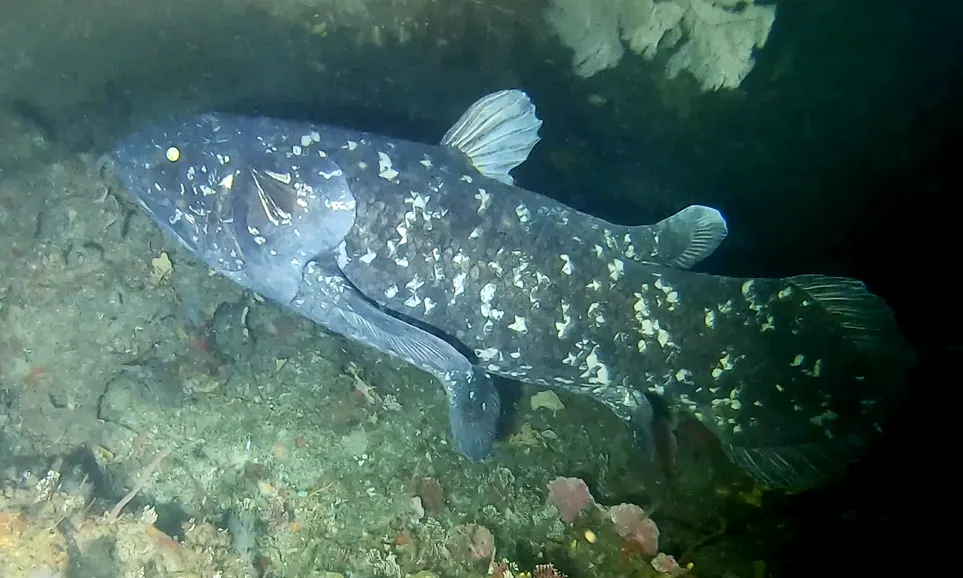
In this catalog, Coelacanthi stands for coelacanths, a very old lineage of lobe-finned fishes. We list 1 coelacanths that the IUCN Red List records as threatened enough to be Critically Endangered, Endangered or Extinct in the Wild: 1 Critically Endangered.
This is the only member of the group in the catalog, so the whole shelf is one record.
A class is a filing shelf, not a measure of risk: it says nothing about how fast any one species is declining. Status and assessment years come from the IUCN Red List (version 2026-1); how to read an IUCN assessment explains what the categories and criteria mean, and each record links to its own assessment.
Coelacanths are a very old lineage of lobe-finned fishes, the group that also includes lungfishes and, much further back, the ancestors of land vertebrates. The lineage goes back to the Early Devonian, more than 410 million years ago. Fossils stop about 66 million years ago, and for a long time that was taken as the end of the story.
It wasn't. In December 1938 the museum curator Marjorie Courtenay-Latimer spotted an odd fish in a fisherman's catch off the east coast of South Africa, and the ichthyologist J. L. B. Smith confirmed its importance. Today two living species are recognised, both in the genus Latimeria: one in the western Indian Ocean and one in Indonesia. Genetic studies suggest the Indonesian population may include more than one species.
Why these animals are threatened
Coelacanths live deep. The western Indian Ocean species is usually found at about 70 to 140 metres (fishers' accounts from the Comoros put it at 150 to 700 metres), and the Indonesian species at 100 to 700 metres. Nobody targets them. The main danger is bycatch, when fishing gear set for other deep-water fish or sharks hauls one up.
They also reproduce slowly. Females give birth to live young in groups of 5 to 25 pups, and maturity is believed to come after about 20 years. Gestation was once estimated at 13 to 15 months, though research in 2021 suggests it could last up to five years. A species like that can't absorb many losses.
Numbers are small and uncertain. One estimate from 1998 put the Comoran population at 500 or fewer, and a 1991 to 1994 decline was estimated at about 30% (an estimate, not a count). These are old figures, and no current authoritative count turned up. The western Indian Ocean species has been on CITES Appendix I since 1989, and Indonesian law protected the Indonesian species soon after its discovery, though accidental catches still happen.
What the catalog lists
The catalog has 1 record in this group, the West Indian Ocean coelacanth (Latimeria chalumnae), listed as Critically Endangered. It sits in the order Coelacanthiformes and the family Latimeriidae.
The Indonesian coelacanth isn't among the catalog's records. It is assessed as Vulnerable, a lower category than the catalog covers. A single record shouldn't be read as a sign the group is doing fine. It reflects how few species are left in the lineage at all.
Sources for this section
- Coelacanth, Wikipedia: lineage age, 1938 discovery, two living species, bycatch, live birth and gestation, maturity
- West Indian Ocean coelacanth, Wikipedia: depth range, 1998 population estimate, 1991 to 1994 decline, CITES Appendix I
- Indonesian coelacanth, Wikipedia: Sulawesi discovery 1997 to 1998, depth 100 to 700 m, threats, Vulnerable status, Indonesian protection
Status breakdown
1 records: Critically Endangered 1.
All species
Coelacanthiformes (1)
- West Indian Ocean coelacanth Latimeria chalumnae CR
The A to Z index lists the species with a full account; the catalog search finds any record by name.
Quick answers
- How many coelacanths are in this catalog?
- 1, listed by the IUCN Red List as 1 Critically Endangered.
- What is Coelacanthi?
- Here, Coelacanthi means coelacanths, a very old lineage of lobe-finned fishes. It is a taxonomic class used to group the catalog.
- Where do the statuses come from?
- From the IUCN Red List (version 2026-1), with a link to each species' assessment on iucnredlist.org.